How Outdoor Team Challenges Boost Problem-Solving Skills: A Practical Guide for Leaders
Outdoor team challenges create measurable improvements in problem-solving by reducing cortisol levels, restoring directed attention, and removing workplace hierarchies that typically inhibit collaboration.

Key Takeaways
- •Natural environments boost cognitive performance by 20-34%, with nature exposure improving working memory, reducing anxiety, and increasing brain plasticity through physical movement.
- •Effective outdoor team building requires matching activities to specific skill gaps - analytical thinking, creative problem-solving, time-sensitive decisions, or trust-building - rather than generic exercises.
- •The debrief session determines success: teams engaging in structured post-activity reflection improve subsequent task performance by 25% compared to those who skip this critical step.
- •Leaders must guide without rescuing by asking "What have you tried?" instead of providing solutions, creating productive discomfort where genuine problem-solving thinking occurs.
- •Budget £50-£150 per person for quality facilitation and relevant activities, allocating 5-10% contingency for unexpected costs while prioritising inclusive design over premium venues.
The transformation happens not during the outdoor activity itself, but in the facilitated reflection that connects outdoor lessons to workplace scenarios. Without this bridge, even the most engaging challenge becomes merely a memorable day out rather than a catalyst for lasting behavioural change. More than 85% of employees in leadership positions report that lack of collaboration is the top reason for failures in the workplace. Outdoor team challenges boost problem-solving skills and can help reverse this trend. Employees who participate in teamwork show a 20% increase in productivity. Outdoor team building creates the ideal environment for developing these critical capabilities through hands-on problem-solving activities that strengthen collaboration and decision-making.
We'll get into the science behind outdoor learning in this piece and provide practical strategies for facilitating team problem-solving challenges that deliver measurable results. You'll also find effective team building exercises focused on problem-solving.
Understanding Problem-Solving in Team Dynamics
Teams that solve problems effectively follow a structured approach. Groups often spiral into unproductive discussions or rush to implement solutions that address symptoms rather than root causes without clear frameworks.
The Five Stages of Problem-Solving
Problem-solving in teams requires a systematic process that guides collaborative efforts toward practical outcomes. The five-stage framework provides a roadmap that keeps teams focused and productive.
Stage 1: Define the Problem. Teams must express the challenge clearly and phrase it as probing questions rather than predetermined solutions. Asking "what factors are causing missed deadlines?" is different from stating "we need to change our workflow process." The former encourages explorative thinking while the latter limits potential solutions.
Stage 2: Analyse the Problem. This stage involves finding root causes rather than treating surface-level issues. Teams get into whether problems stem from human error, insufficient training, unpredicted circumstances, or other processes and barriers. Assumptions and biases become critical to identify during this phase.
Stage 3: Identify and Select Potential Solutions. Multiple perspectives lead to broader solution ranges. Teams brainstorm potential approaches and ensure all members contribute ideas before evaluating any single option. Diversity of thought at this stage prevents groupthink and uncovers innovative solutions.
Stage 4: Develop a Plan to Implement the Solution. Teams determine specific steps, assign responsibilities, establish timelines, and identify required resources. Clear accountability measures prevent confusion about who handles each implementation component.
Stage 5: Assess the Effectiveness of the Solution. Monitoring and evaluation determine whether the solution works as intended. Teams gather feedback, track progress against defined metrics, and make adjustments based on outcomes.
Why Teams Struggle With Problem-Solving
Several factors derail team problem-solving efforts. Teams with unclear or unknown purposes lack direction and find it nearly impossible to arrange solutions. Groups that comprise people from similar backgrounds, experiences, or education levels fail to bring the diversity of thought required to challenge perspectives and find innovative approaches to old problems.
Trust issues erode collaborative problem-solving. Team members become skeptical of intent and agendas, which prevents harmonious work toward agreed goals. Poor communication compounds these challenges. Teams miss valuable insights that could reshape their approach when individuals avoid speaking up, especially when you have different or controversial views.
Conflict affects many team constructs in different ways. Healthy conflict generates interesting discussions and pushes for new outcomes. Unhealthy conflict triggers unpleasant results and damages relationships. Unclear roles create another pervasive problem. Some members overstep boundaries while others duplicate efforts or leave tasks incomplete without stated responsibilities.
Hidden agendas drive participants to operate in isolation from other team members and fragment collective efforts. Physical isolation has led individuals to believe they work better independently in some cases, though history suggests otherwise.
The Role of Environment in Team Performance
Environmental factors shape how effectively teams solve problems. Research that looks at organisational variables reveals five significant associations with project team performance. Professionally stimulating and challenging work environments show the strongest correlation, followed by opportunities for accomplishments and recognition, knowing how to resolve conflict and problems, clearly defined organisational objectives relevant to the project, and job skills and expertise appropriate for the project work.
These factors deal effectively with integrating goals and needs between team members and the organisation. More subtle elements become catalysts for cross-functional communication, information sharing, and ultimate team integration focused on desired results.
Environmental conditions extend beyond organisational culture. Air pollution affects team performance in measurable ways. Research on escape room challenges found that completion time increased by up to 5% (approximately 3.2 minutes) between low and high-pollution days. Cognitive functioning drives creativity and innovative thinking, so air quality constitutes a potential pathway by which environmental factors negatively affect team performance.
Teams with higher innate abilities and problem-solving skills demonstrate greater self-sufficiency and require fewer external hints to guide challenges successfully. This observation underscores how environment interacts with team capabilities to shape problem-solving outcomes.
The Science Behind Outdoor Learning and Problem-Solving
Natural outdoor environments trigger biological changes that alter how we think and solve problems at a basic level. These mechanisms explain why outdoor team building produces measurable improvements in cognitive performance and collaboration.
How Nature Affects Brain Function
Time spent outdoors reduces cortisol levels, the hormone responsible for stress. This physiological change creates conditions where employees participate fully in problem-solving activities without feeling overwhelmed. Research on attention restoration demonstrates that natural environments restore directed attention from fatigue through a process called "soft fascination."
Trees, flowers, and water in natural settings contain inherently fascinating stimuli that modestly draw upon involuntary attention. Directed-attention mechanisms can replenish. Urban environments contain bottom-up stimulation that captures attention dramatically and requires processing multiple sources of information at once, in contrast.
Studies measuring working memory performance found substantial improvements after nature exposure compared to urban environments. Participants who walked in natural settings for 50 minutes showed decreased anxiety, rumination, and negative affect. Working memory performance increased alongside these changes. The backwards digit span task taxes directed attention through encoding, maintenance, and active processing. This task showed particularly strong improvements following nature interactions.
Brain imaging reveals the neurological basis for these changes. A 60-minute walk in a natural environment produced lower activation of the amygdala compared to urban walks. The amygdala is the brain structure that signals fear and threat. Blood flow in the prefrontal cortex decreased and correlated with reduced rumination after 90-minute nature walks.
The Connection Between Movement and Cognition
Physical activity improves cognitive function through multiple pathways. Aerobic walking improved performance on sequential memory tests and feature detection tasks across age groups substantially. College-aged participants showed a 34% increase in feature detection performance and a 20% increase in sequential memory tasks after just 10 minutes of walking.
Physical activity improves brain plasticity and cognitive function substantially. A single 30-minute period of physical activity increases neuroplasticity with identifiable positive effects in motor-skill coordination and declarative memory. Hormonal changes and alterations to brain volume drive these mechanisms.
Physical activity triggers brain-derived neurotrophic factor (BDNF). BDNF supports synaptogenesis in the basal forebrain and hippocampus. These areas are the foundations of memory, learning, and thinking. Motor activity conducted in enriched environments causes structural modifications of the nervous system and behavioural changes through increased learning ability. Spatial and problem-solving abilities improve particularly.
Outdoor exercise delivers greater cognitive benefits than indoor exercise. Participants who walked outside performed better on cognitive tasks than those who walked inside. The amplitude of the P300 increased following outdoor walks but not indoor walks. This event-related neural response is associated with attention and working memory.
Why Outdoor Settings Lower Barriers to Collaboration
Outdoor environments create neutral ground that breaks down hierarchical barriers. The informal setting encourages team members to connect on a personal level and develop trust. Interpersonal relationships strengthen. Open spaces and fresh air promote mental clarity and rejuvenate participants. They function as a reset button for mind and body.
Day-to-day distractions that limit creativity disappear when you leave the office. Employees approach outdoor team problem-solving challenges with fresh points of view and work with colleagues they may not usually work alongside. The relaxed atmosphere helps participants feel comfortable contributing ideas and working together.
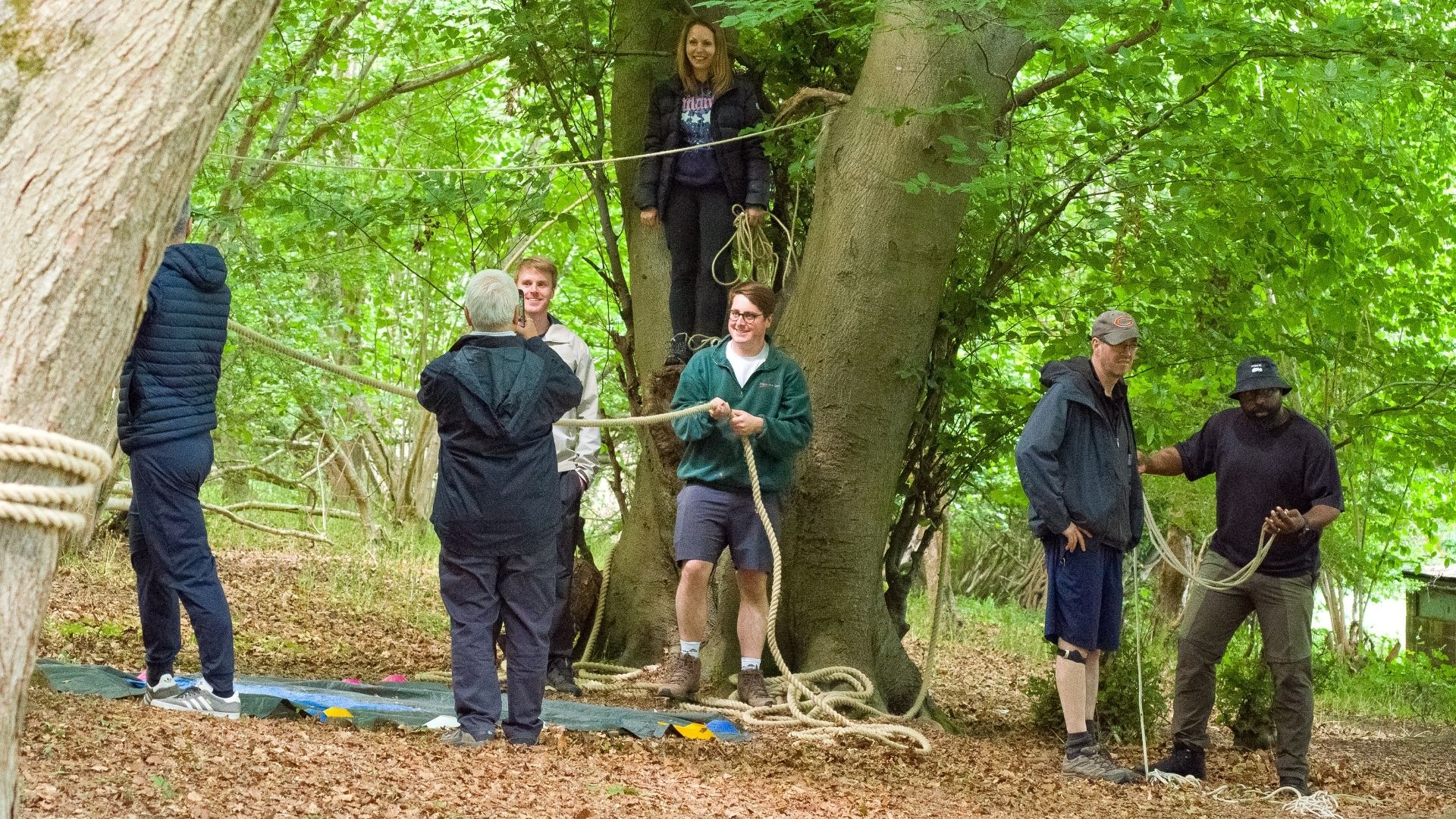
Natural settings encourage open and spontaneous communication. The outdoor environment promotes casual conversations and discussions that might not occur in traditional office settings, whether you're navigating problem-solving activities or completing team challenges. Physical activities require participants to lean on teammates, coordinate actions in real-time, and practice active listening. Rope bridges are a good example.
Reduced stress, improved mood, and increased energy levels combine to create an experience that proves both enjoyable and productive. Teams participate in physical coordination and mutual support while solving problems. This encourages collaboration that translates back to workplace scenarios directly.
Types of Outdoor Team Problem-Solving Challenges by Skill Focus
Different outdoor team building activities target distinct cognitive capabilities. Matching activities to specific skill development goals produces better outcomes than generic team-building approaches.
Analytical Thinking Challenges
Murder mystery scenarios place teams inside structured investigations where they must get into evidence, identify patterns and reach logical conclusions. Activities like Clue Murder Mystery challenge groups to determine who had the means, motive and opportunity to commit a crime. The CI: Crime Investigators format provides teams with evidence sets and time constraints. This forces analytical approaches that get into facts in a systematic way.
Geocaching develops spatial reasoning when combined with problem-solving tasks. Teams use GPS devices to locate hidden containers while solving riddles at each location. Participants get pushed beyond simple navigation into analytical territory. They must decode clues and think about routes strategically.
Outdoor detective role-playing assigns specific investigative roles. The Lead Detective manages the investigation. The Forensic Expert analyses physical evidence like footprints. The Cryptographer decodes messages, and the Record Keeper documents findings. Witnesses possess information they reveal only when sharp-minded detectives ask precise questions.
Escape rooms adapted for outdoor settings create scenarios where teams solve interconnected puzzles under time pressure. Every person must contribute. Going solo or waiting for others to figure things out fails in these environments.
Creative Problem-Solving Activities
Cardboard boat building transforms limited materials into functional watercraft. Teams receive cardboard and tape, then design vessels they'll test on water. The challenge forces creative thinking about buoyancy, structural integrity and weight distribution. Groups must also deliver presentations that explain their design rationale before the water test.
The egg drop gives teams building materials like popsicle sticks, cotton balls, newspapers or balloons to construct protective containers. All eggs drop from identical heights after 20-30 minutes of construction. Surviving eggs advance to higher drops until one remains.
Tower building challenges include balloon towers, cardboard box structures and pipe bridges. These activities blend engineering mindset with collaborative iteration. Catapult building adds competitive elements where teams engineer working devices, then compete on distance and accuracy.
Time-Sensitive Decision-Making Exercises
Relay-style missions and navigation exercises force teams to coordinate, prioritise and adapt without familiar office hierarchies. Authentic leadership behaviours surface when pressure enters physical environments.
Survival adventures in wilderness settings just need situational awareness, strategic decision-making and fast creative problem-solving. Teams orienteer, start fires and make rapid choices with minimal equipment. The wilderness poses problems that require immediate solutions.
City race formats modelled after competitive reality shows test resourcefulness and time management as teams complete strategic missions in urban environments. Wild Goose Chase uses app-based challenges that require creativity and quick thinking to complete photo and video tasks around neighbourhoods.
Weather changes, varying participant capabilities and unexpected situations create immediate feedback loops. Learning happens faster than classroom scenarios.
Trust and Communication Builders
Blindfold activities strip away visual cues and make communication precision critical. Blindfolded team members guide obstacle courses in the minefield game. They rely only on shouted directions from teammates. The pipeline challenge requires participants to use individual pipe segments to deliver objects like golf balls to buckets. This just needs teamwork and collaboration.
Blindfold build exercises pair participants where one wears a blindfold while their partner provides verbal instructions to stack cups, arrange blocks or balance objects. Teams swap roles so everyone experiences both trust positions.
The human knot asks circle participants to grab hands of two different members across from them, then unravel without breaking grip. Back-to-back drawing emphasises clear instructions and knowing how to trust guidance.
These activities remove traditional office hierarchy. Team members bond and build relationships that extend beyond workplace settings.
Selecting the Right Outdoor Team Building Activities
Selection starts with honest assessment of where your team stands and where it needs to go. Vague objectives produce vague results. If your team struggles with cross-functional communication, the activity should create conditions where communication breaks down under pressure. Teams can then get into why this happens and develop better habits. If leadership transitions prove inconsistent, the programme should surface that dynamic.
Match Activities to Team Goals
Team composition determines development needs. A newly formed team requires different challenges from one that has worked together for years but fallen into unhealthy patterns. Executive and leadership teams often need challenges that address strategic thinking and accountability at the senior level rather than general engagement activities. Coordinating outdoor team building exercises across multiple locations? Choose venues within 90-150 minutes of major transportation hubs to reduce transit fatigue.
Consider Logistics and Budget
Most organisations spend between £50-£150 per person for outdoor team building. The total budget breaks down as roughly £40 for food and drink, £13 for transportation, and £52 for the activity itself. Low-budget options like hiking or group games cost under £20 per person and cover logistics or refreshments. Premium options such as adventure courses or retreats reach £120-£320+ per person.
Allocate 5-10% of your total budget as contingency for unexpected costs, especially for off-site events. Focus spending on quality facilitation and activity relevance rather than luxury catering or premium venues. These factors drive return on investment far more than aesthetics.
Account for Diverse Fitness Levels
Design that works for everyone proves critical when working at scale. Plan varied roles so people can use different strengths beyond physical ability. Include options for those who prefer planning, coordination, or creative tasks. Activities should feature balanced physical demands so everyone contributes.
Your group has marathon runners alongside colleagues who avoid stairs whenever possible. Lean too far toward high-energy activities and many may choose not to participate at all. Slow-paced activities leave thrill-seekers bored. Mixed ability covers mobility restrictions, varying comfort levels, and diverse risk appetites.
Balance Fun With Learning Outcomes
The outdoor activity itself serves as the vehicle. The debrief and facilitated reflection are where development happens. Quality of the facilitator determines whether the day produces laughter and good memories, or genuine lasting change. A professional events team should manage risk and shape the experience so it links back to your business goals, not just a fun day out.
Curious what a day at Into The Woods looks like for your team? Get in touch for a free 15 minute call and we'll talk through what we can build for you.
A single outdoor event, but powerful, will not sustain long-term performance improvement on its own. The most effective approach integrates outdoor experiences into a broader development experience.
A Leader's Guide to Facilitating Outdoor Problem-Solving Sessions
Facilitation determines whether outdoor team building produces lasting behavioural change or just memorable photos. Your role changes from problem-solver to guide. You create conditions where teams find solutions themselves.
Pre-Activity Preparation and Briefing
Establish ground rules before you begin. This applies to tool use or fire circles if your session has them. Explain why these rules exist so participants understand their importance rather than viewing them as arbitrary restrictions. Arrange the team on specific company values you want them to focus on during the challenge, whether that's collaborative state-of-the-art or bias for action.
Brief teams on equipment allocation and provide necessary training. Prepare route maps. Each challenge requires teams to read and understand all conditions specified in briefing sheets. They must adhere to them. Simple navigational skills warrant a short refresher before events kick off.
Setting Up the Challenge Environment
Plan logistics with care. Have all necessary supplies on hand before you begin. This means tools or materials needed for building structures or completing tasks. Estimate how long each task will take for longer sessions with multiple activities. You can adjust based on how groups work through challenges.
Position challenges at different sites along routes where teams arrive by specified times. The problem-solving tasks vary in nature and draw out different qualities and skills from within the team.
Guiding Without Giving Away Solutions
Ask a question before giving an answer when someone brings you a problem. You're not withholding help but redirecting thinking back to them. Stay available if they get stuck. Ask "What have you tried so far?", "What options do you see?", or "If I weren't here, what would you do?"
The first few times feel awkward for both of you. Stay with the question. That discomfort is where thinking happens. You've undone the whole exercise if you rescue at the first sign of struggle.
Managing Group Dynamics During Activities
Pay close attention to how individuals interact, who takes the lead, and which team members need encouragement. Watching and observing group interactions can prove just as valuable as the activity itself. Provide positive reinforcement throughout the process. Celebrate successes and encourage teams when they hit roadblocks or become frustrated.
Address conflicts without delay. Problems left to fester damage team bonds, sometimes beyond repair. Keep communication open by inviting colleagues to discuss differences face-to-face.
Post-Activity Reflection and Discussion
Facilitate an immediate debrief after each challenge. Teams that participate in structured debriefs improve their performance on subsequent tasks by an average of 25%. Ask open-ended questions like "What did you notice about our process?" or "At what point did we change our plan, and why?"
Document observations about how teams assign tasks and manage stress. Note how they use individual strengths. These insights provide valuable data for future training sessions. Give teams the opportunity to review their performance and take forward learning to the next challenge after completion of each task.
Common Obstacles and How to Overcome Them
Resistance, weather disruptions, and disconnected learning experiences sabotage even well-designed outdoor team building. Whether your investment produces lasting change depends on how you address these obstacles in advance.
Resistance From Team Members
Pushback often stems from fear of the unknown or disruption of comfortable routines. Find evangelists within your group who recognise the benefits of working together. These individuals can lead communication efforts and make it safer for reluctant members to begin trusting each other. Enable these champions to set the agenda for team building activities and give them ownership of the process.
Transparent communication proves vital. Express why the outdoor session matters and how it benefits both the organisation and individuals. Regular updates and open-door policies for feedback reduce uncertainties and anxieties. Involve team members in planning the outdoor team building experience. Employees welcome change more when they feel their input matters.
Not everyone will join in fully. Accept that some never warm to team concepts despite your best efforts. Include them but don't force participation beyond their comfort level. Watch for disruptive or passive-aggressive behaviour, but otherwise let them participate at their own pace.
Weather and Environmental Concerns
British weather remains unpredictable, but wet weather contingency plans allow you to transition activities to indoor environments without compromising goals. Rain tests commitment powerfully. Teams who proceed often find that continuing proves more satisfying than retreating. This teaches lessons about the relationship between original resistance and ultimate satisfaction, especially valuable for workplace challenges that provoke similar hesitation.
Adverse conditions build practical creativity. Solving problems with damp wood or wet equipment develops tangible skills and builds broader capacity for working around constraints.
Applying Outdoor Lessons to Workplace Scenarios
Students who struggle in traditional classroom settings especially enjoy challenging outdoor sessions and develop confidence that transfers to more positive learning attitudes. The key lies in structured reflection right after outdoor team problem-solving challenges, where teams identify specific workplace applications for newly developed problem-solving skills.
Conclusion
Outdoor team challenges deliver measurable improvements in problem-solving when you match activities to specific team needs and guide them the right way. We've explored how natural environments reduce stress and create ideal conditions for shared learning.
The key lies in what happens after the activity. Even the most engaging outdoor session becomes just a fun day out without structured reflection and workplace application. Choose challenges that mirror your team's obstacles, guide without rescuing, and run immediate debriefs that connect outdoor lessons to daily work.
Start with a full picture of where your team struggles. Then design experiences that surface those dynamics under manageable pressure. Explore our custom events to plan a problem-solving day tailored to your team, or book a public event to try it yourself first.
FAQs
Q1. What are the five stages of effective team problem-solving?
The five stages are: defining the problem clearly through probing questions, analysing root causes rather than symptoms, identifying and selecting potential solutions through brainstorming, developing a detailed implementation plan with assigned responsibilities, and assessing the solution's effectiveness through monitoring and feedback.
Q2. How does spending time outdoors improve cognitive function and problem-solving abilities?
Natural environments reduce cortisol levels and stress, restore directed attention through "soft fascination," and improve working memory performance. Brain imaging shows decreased amygdala activation and reduced rumination after nature exposure. Additionally, outdoor physical activity increases brain-derived neurotrophic factor (BDNF), which supports memory, learning, and thinking.
Q3. What types of outdoor activities are best for developing analytical thinking skills?
Murder mystery scenarios, geocaching with problem-solving tasks, outdoor detective role-playing with assigned investigative roles, and adapted escape rooms are excellent for analytical thinking. These activities require teams to examine evidence, identify patterns, decode clues, and reach logical conclusions under structured conditions.
Q4. How much should organisations budget for outdoor team building activities?
Most organisations spend between £50-£150 per person for outdoor team building. The typical breakdown includes roughly £40 for food and drink, £13 for transportation, and £52 for the activity itself. It's recommended to allocate 5-10% of the total budget as contingency for unexpected costs.
Q5. Why is post-activity reflection important for outdoor team building success?
Structured debriefs after outdoor challenges improve team performance on subsequent tasks by an average of 25%. The reflection session is where actual development happens, as teams identify specific workplace applications for newly developed skills. Without this structured reflection, even engaging outdoor sessions become just memorable experiences rather than lasting behavioural change.
Ready to experience the woods for yourself?
See Upcoming Events