Corporate Team Building Activities: A Strategic Guide for Business Leaders
Teams engaging in regular team building show 35% higher productivity and 23% greater profitability. Here is the strategic guide to corporate team building that actually delivers measurable business results.

Key Takeaways
Corporate team building delivers measurable business impact when done strategically. Here is what business leaders need to know:
- •
Teams engaging in regular team building show 35% higher productivity and 23% greater profitability, with engaged employees 87% less likely to leave - saving companies an average of £30,614 per avoided replacement.
- •
Outdoor wilderness activities outperform traditional indoor formats by creating authentic challenges where natural collaboration must occur, revealing leadership qualities and communication patterns that transfer directly to workplace dynamics.
- •
Effective team building requires strategic planning beyond one-time events: assess specific team needs, match activities to desired outcomes, establish baseline metrics, and measure sustained behavioral changes at 3 and 6 months post-event.
- •
Nature-based experiences like bushcraft, shelter building, and adventure challenges break the cycle of predictable corporate activities by combining skill development with environmental impact, creating memorable experiences that strengthen bonds through shared vulnerability.
- •
Large-scale activities (50-200+ participants) demand different approaches than small team exercises, requiring clear structure, visible scoring systems, and formats where everyone contributes rather than watches - from Office Olympics to coordinated multi-venue escape rooms.
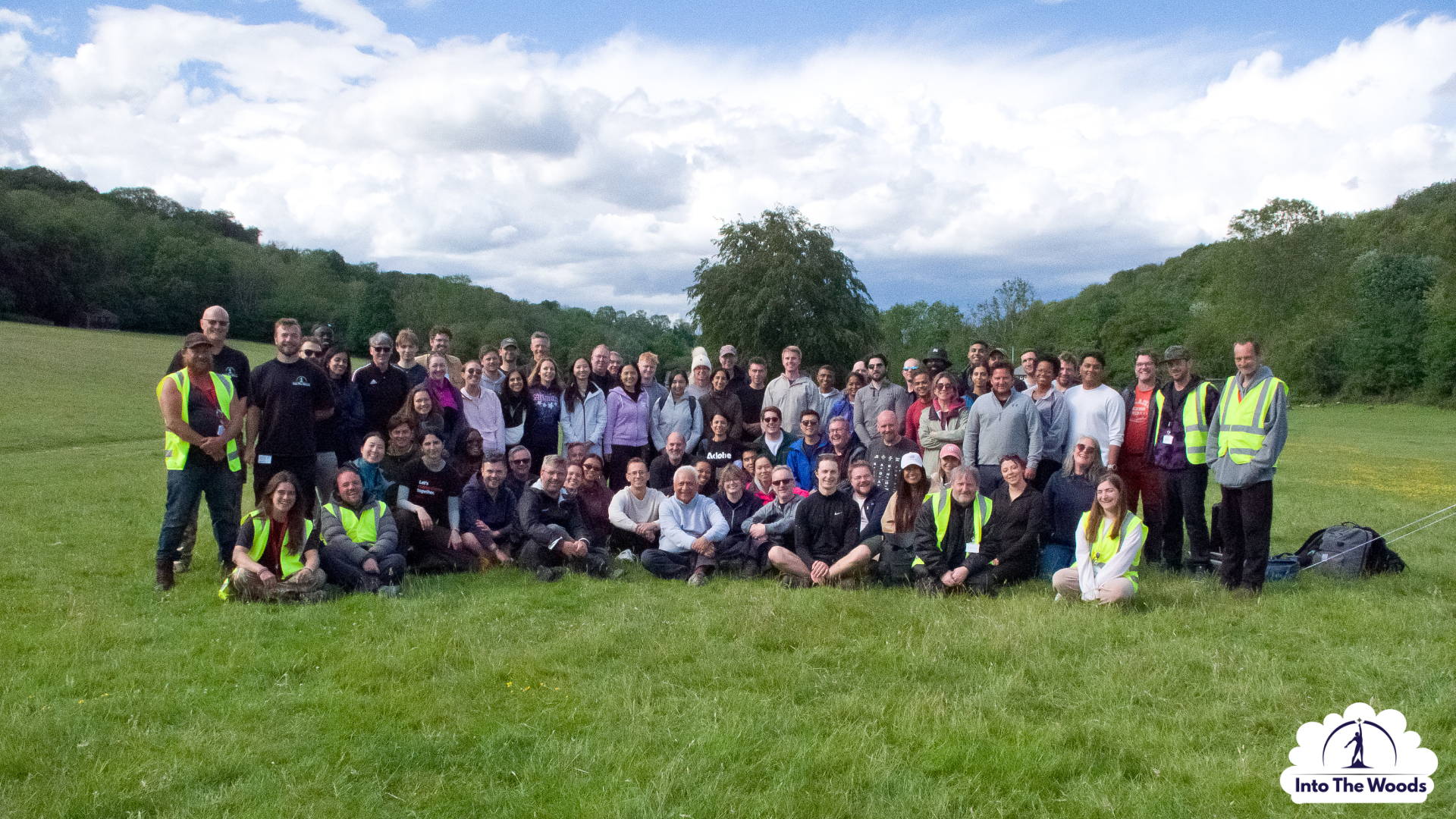
Corporate team building activities are not just social events. Teams participating in regular team building demonstrate 35% higher productivity rates. Highly engaged teams show 23% greater profitability. Most companies default to the same tired activities year after year. We believe it is time to move beyond standard approaches and explore unique corporate team building outdoor activities that strengthen bonds and develop skills. Activities like wilderness survival and bushcraft workshops with Into the Woods will show you how to create memorable experiences that deliver measurable results for any team size.
The Strategic Benefits of Corporate Team Building Activities
"Despite its reputation for being, well, lame, team building is the most important investment you can make for your people." - Brian Scudamore, Founder and CEO of O2E Brands
Better Team Performance and Productivity
Research from the University of Warwick reveals that happiness makes people approximately 12% more productive. This connection between wellbeing and output forms the foundation of why corporate team building activities deliver tangible business results. Colleagues who communicate openly, understand each other's strengths, and trust one another make everyday tasks more efficient. Teams spend less time navigating misunderstandings and work together with greater confidence.
Studies suggest effective teamwork can boost productivity by up to 30%, achieved through better cooperation, reduced conflict, and quick task completion. The financial implications are huge. Organizations that invest in engagement see a 17% increase in productivity, which translates to roughly 20% higher sales and approximately 21% greater profitability. Corporate team building outdoor activities like wilderness survival with Into the Woods push teams to work together in unfamiliar environments where natural problem-solving must occur, unlike standard indoor workshops.
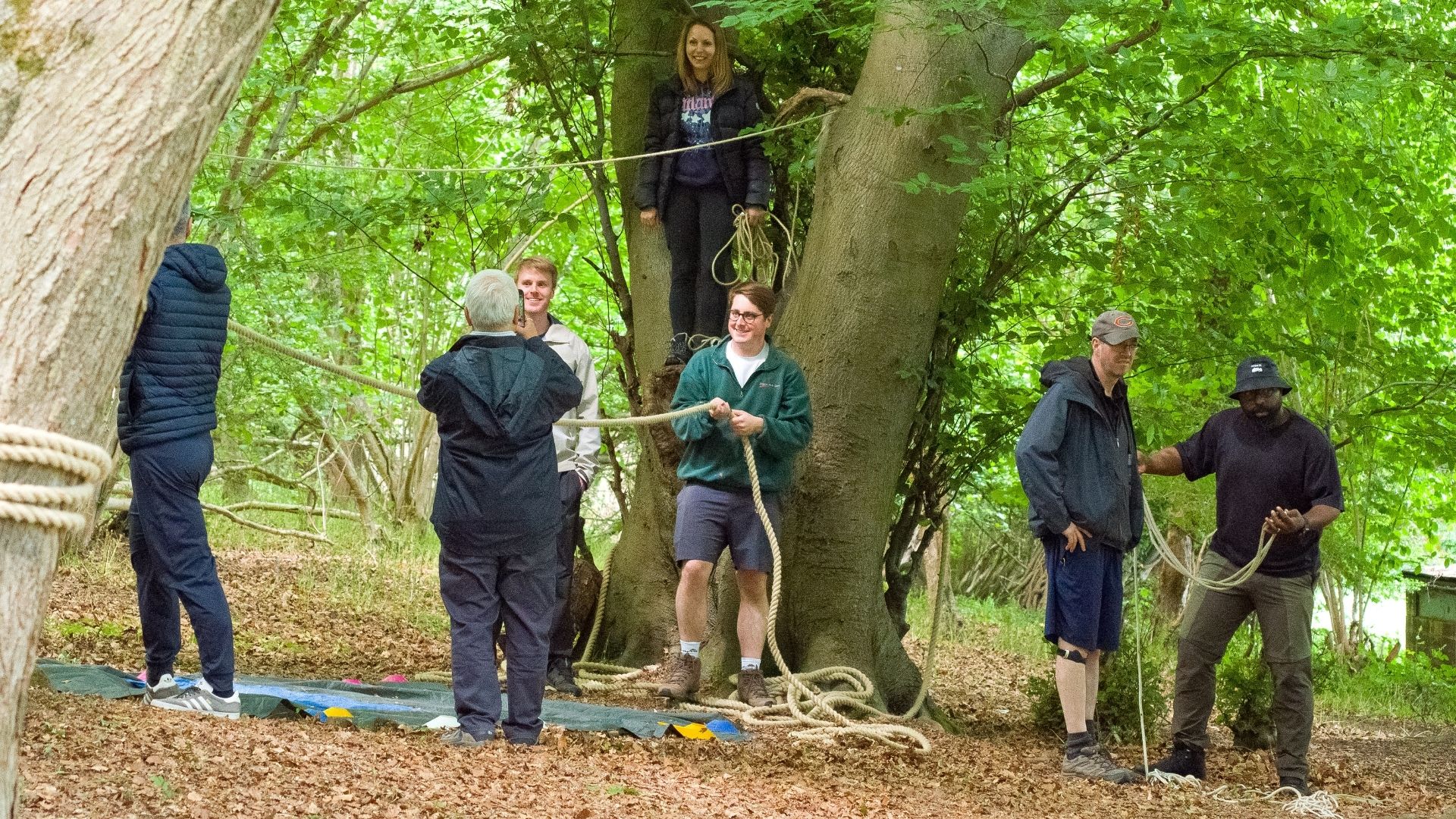
Activities such as shelter building and groundbreaking challenges require immediate collaboration. Teams quickly find who excels at planning, who takes action, and how to combine these strengths when constructing debris shelters using natural materials or learning rope work to build structures under pressure. These insights transfer directly back to workplace dynamics.
Better Employee Engagement and Retention
Employees who feel a strong sense of belonging and connection to their team experience a 56% increase in job engagement. This matters because engaged employees are 87% less likely to leave a company. The financial stakes are substantial. Replacing a single worker costs £30,614 in the UK, factoring in the 28 weeks required for a new employee to reach full productivity.
Highly engaged teams demonstrate a 21% to 51% reduction in turnover, depending on the industry. Organizations with high engagement levels also observe 41% reduced absenteeism and 70% lower safety incidents. These numbers reflect what happens when people feel valued and connected to their colleagues rather than isolated in their roles.
Team building activities encourage open communication, trust, and mutual respect in relaxed, non-judgemental environments. Organizations reduce interpersonal barriers and create genuine belonging by providing opportunities for employees to work together outside traditional office settings. Employees commit more fully to company goals and vision when they feel connected to their peers.
Corporate event team building activities that feel like genuine rewards rather than mandatory exercises produce the strongest results. The biggest mistake companies make is booking events to fix broken communication issues. True team building maintains healthy culture, welcomes new hires, or bridges gaps between departments that rarely interact.
Connecting team building with Corporate Social Responsibility and sustainability creates shared, meaningful achievements. Events that allow employees to give back to communities transform from simple work outings into experiences that drive morale and retention. Into the Woods integrates this approach through environmental conservation projects and sustainable team challenges in natural settings, where groups contribute to woodland maintenance while developing skills.
Building Trust and Communication
Trust serves as the heartbeat of any successful team. Collaboration falters, communication breaks down, and performance suffers without it. Communication stands as the single most important factor in successful teamwork, yet it requires more than frequent meetings. It demands openness to suggestions and concerns, asking questions, offering help, and avoiding confusion.
Stephen R. Covey captured this when he stated that trust is "the glue of life" and "the most essential ingredient in effective communication". Trust does not develop overnight. It grows through consistent actions, mutual understanding, and shared experiences. Team building activities provide a practical, experiential method to build trust within safe yet challenging environments. They encourage teams to step out of everyday roles and involve one another in authentic ways.
Activities like archery tag or airsoft missions with Into the Woods create scenarios where trust becomes essential. Team members must coordinate movements, communicate positions, and rely on each other's accuracy in archery tag. These high-energy challenges build trust through shared vulnerability and mutual dependence.
Trust allows employees to feel safe in group environments, creating stability where people comfortably speak up with concerns or alternative suggestions. Combined trust boosts confidence and creates belonging within the workforce, allowing employees to perform jobs more effectively. Colleagues carry these open communication patterns back to their work environment when they communicate freely during activities like campfire experiences or command tasks.
Innovation and Creative Problem-Solving
Team building activities that encourage innovation focus on creative problem-solving, open collaboration, and safe experimentation. The most effective approaches combine structured creativity with psychological safety, allowing team members to share bold ideas without fear of judgment.
Innovation-focused activities break away from traditional exercises by incorporating creative problem-solving elements that mirror real workplace challenges. They encourage participants to think differently, experiment with new approaches, and work together in ways that generate fresh viewpoints. Activities emphasizing process over outcome help teams explore different approaches, learn from failures, and build comfort with ambiguity.
Effective creative challenges include constraints that force innovative thinking. Limited resources, time pressure, or unusual requirements prevent teams from relying on familiar solutions. Teams must design, engineer, and execute under pressure when Into the Woods participants work on siege building or zipline construction with specific materials and time limits. This often produces breakthrough thinking that would not emerge in normal circumstances.
Psychological safety creates environments where team members feel comfortable taking creative risks and sharing unconventional ideas. Participants contribute bold ideas that could lead to genuine innovations when they know they will not face ridicule for unusual suggestions. Teams experiencing psychological safety during activities often maintain more open communication in regular work, leading to ongoing innovation long after the activity ends.
A 2023 PwC survey shows that 77% of CEOs believe collaboration and problem solving are critical to future business success. Creative challenges push teams outside their comfort zones by presenting problems requiring unconventional thinking and collaborative solutions. Activities building structures with limited materials or creating solutions for challenging scenarios teach participants to suspend judgment during idea generation and explore multiple possibilities before selecting solutions.
The collaborative nature of these challenges breaks down hierarchical barriers. Traditional roles dissolve and new viewpoints emerge when everyone struggles with unfamiliar problems. Team members who rarely speak up in meetings often contribute valuable insights during creative challenges. Activities like Into the Woods' bushcraft workshops and large-scale groundbreaking projects require diverse thinking and collective problem-solving that reveals hidden strengths within teams similarly.
Corporate Team Building Outdoor Activities: Beyond Traditional Approaches
Most companies cycle through the same indoor activities year after year. Conference room workshops, trust falls, and icebreaker games feel predictable. Outdoor environments change this dynamic by placing teams in unfamiliar territory where natural collaboration must occur. GPS treasure hunts across city landmarks to wilderness survival with Into the Woods create authentic challenges that standard approaches cannot replicate.
Outdoor Treasure Hunts and Adventure Challenges
GPS treasure hunts combine navigation, problem-solving, and physical exploration into competitive formats that work in urban and rural settings. Teams receive tablets loaded with clues, puzzles, and challenges, then race to complete mandatory tasks while deciding whether bonus challenges warrant the time investment. The format rewards strategic thinking and puzzle-solving ability.
Your event manager briefs the team before they guide themselves through complex puzzles that unlock subsequent steps. The team with the highest score wins at the end of the day. This structure works well for groups between 6 and 100 participants, with hunts lasting one to several hours depending on route complexity.
The F1 Method recreates the coordinated intensity of Formula 1 pit crews through one of the most demanding physical challenges available. Teams design logos and branding, then learn pit crew and driving skills before competing in three high-stakes challenges testing teamwork, communication, and reaction times. F1 teams represent some of the most coordinated groups on the planet and can execute complex work at speeds matching their race cars.
Dragon boat racing has grown from an ancient Chinese ritual into one of the fastest-growing team sports worldwide. Each 40-foot boat accommodates up to 16 people and allows flexible team organization. You can challenge small teams to beat their own scores or organize multiple teams competing at once. Moving as one against harsh waters demands synchronicity while delivering substantial team building benefits. Experienced instructors brief teams on stopping techniques and capsizing prevention, with weak swimmers receiving case-by-case guidance before racing.
Wilderness Survival Skills with Into the Woods
Into the Woods delivers corporate team building activities ideas that break from standard formats. Fire Lighting & Wood Prep teaches teams to become skilled at ferro rods, charcloth, and natural tinders while learning wood selection and safe preparation techniques. These are not theoretical skills. Participants build and sustain actual fires and experience immediate feedback on their collective decisions.
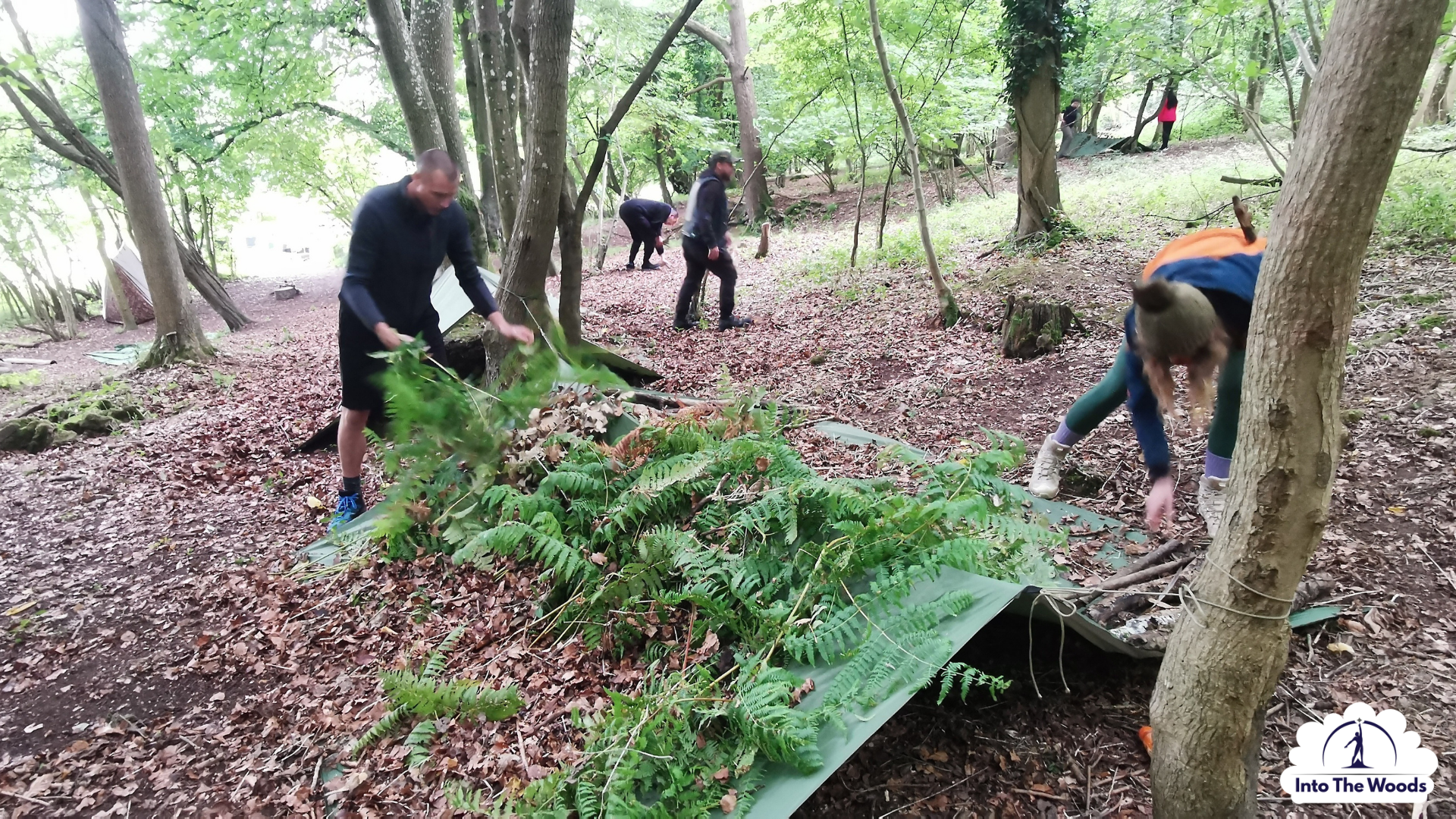
Shelter Building pushes groups beyond their comfort zones. Teams construct debris shelters, tarp setups, and weather-proof structures using only materials from the woodland floor. The activity reveals who leads, who executes, and how groups make decisions under pressure.
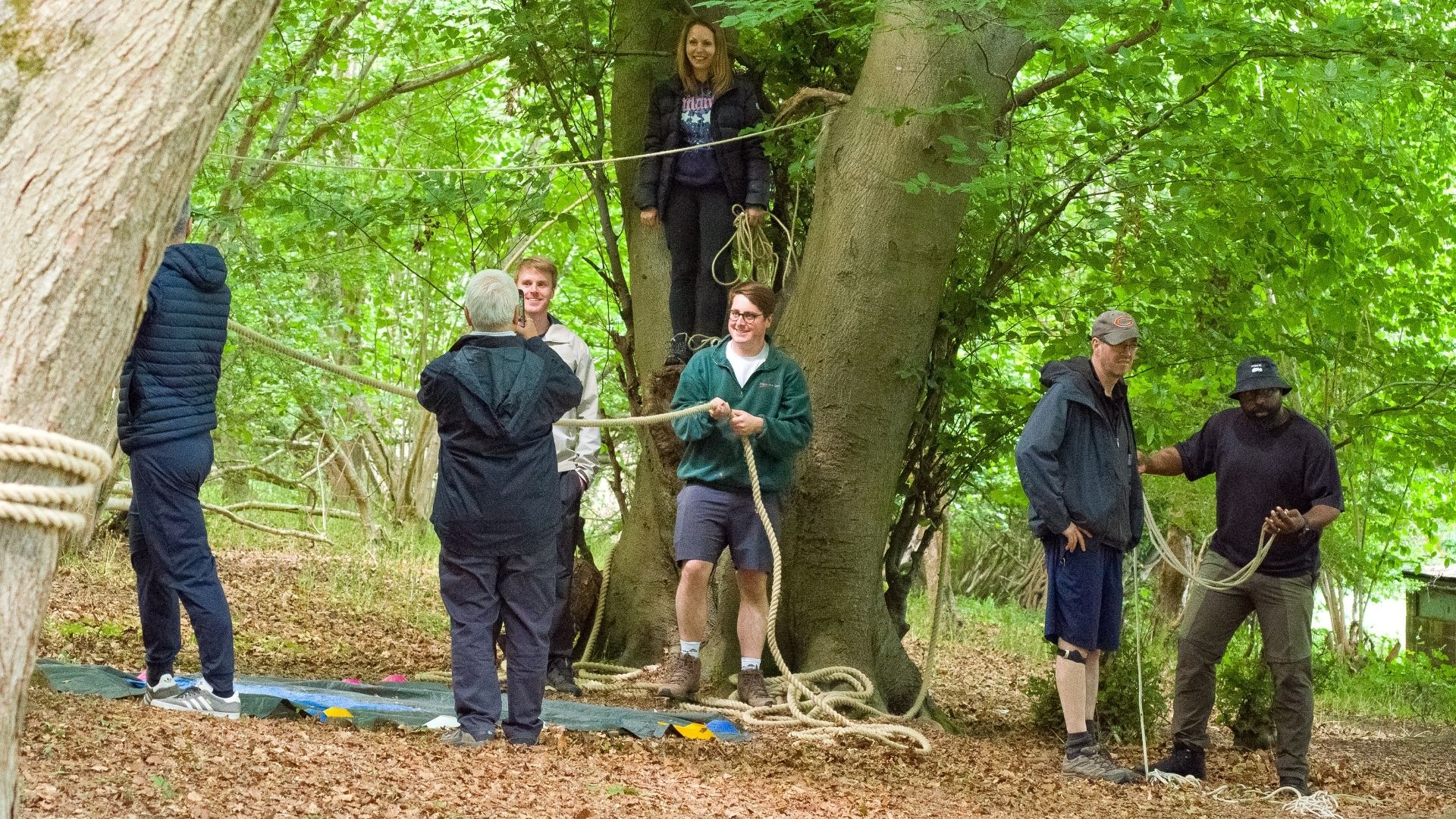
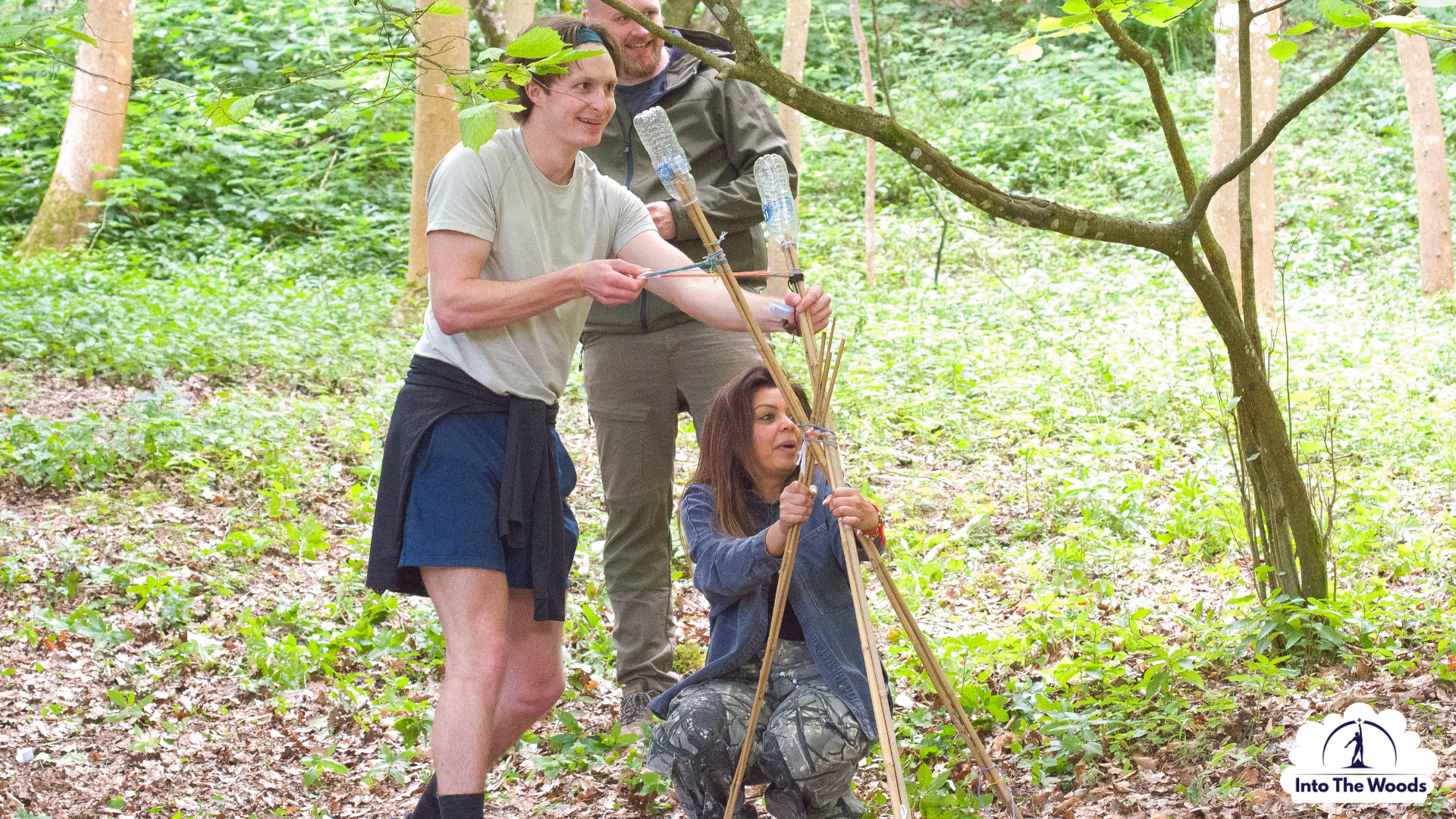
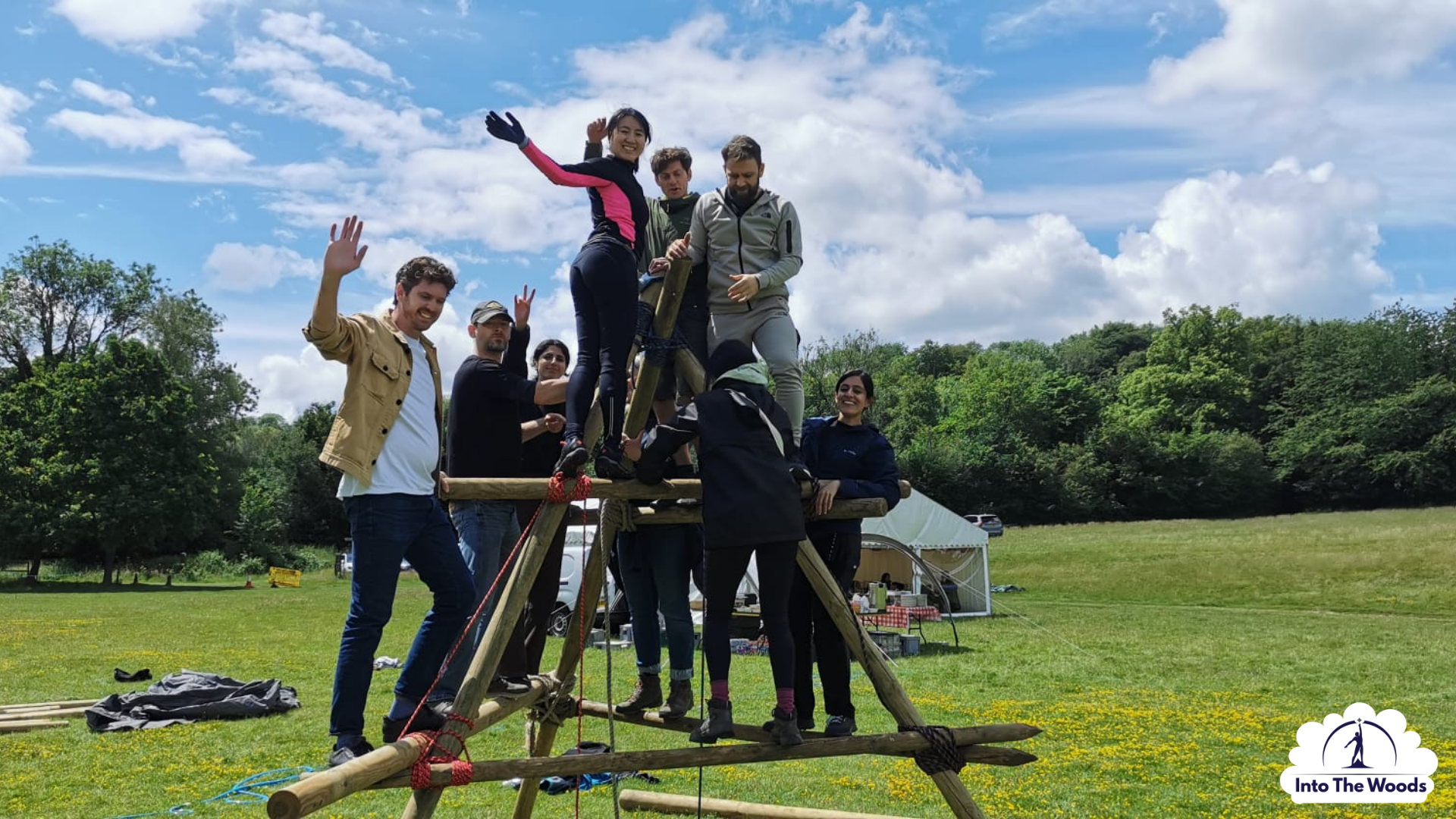
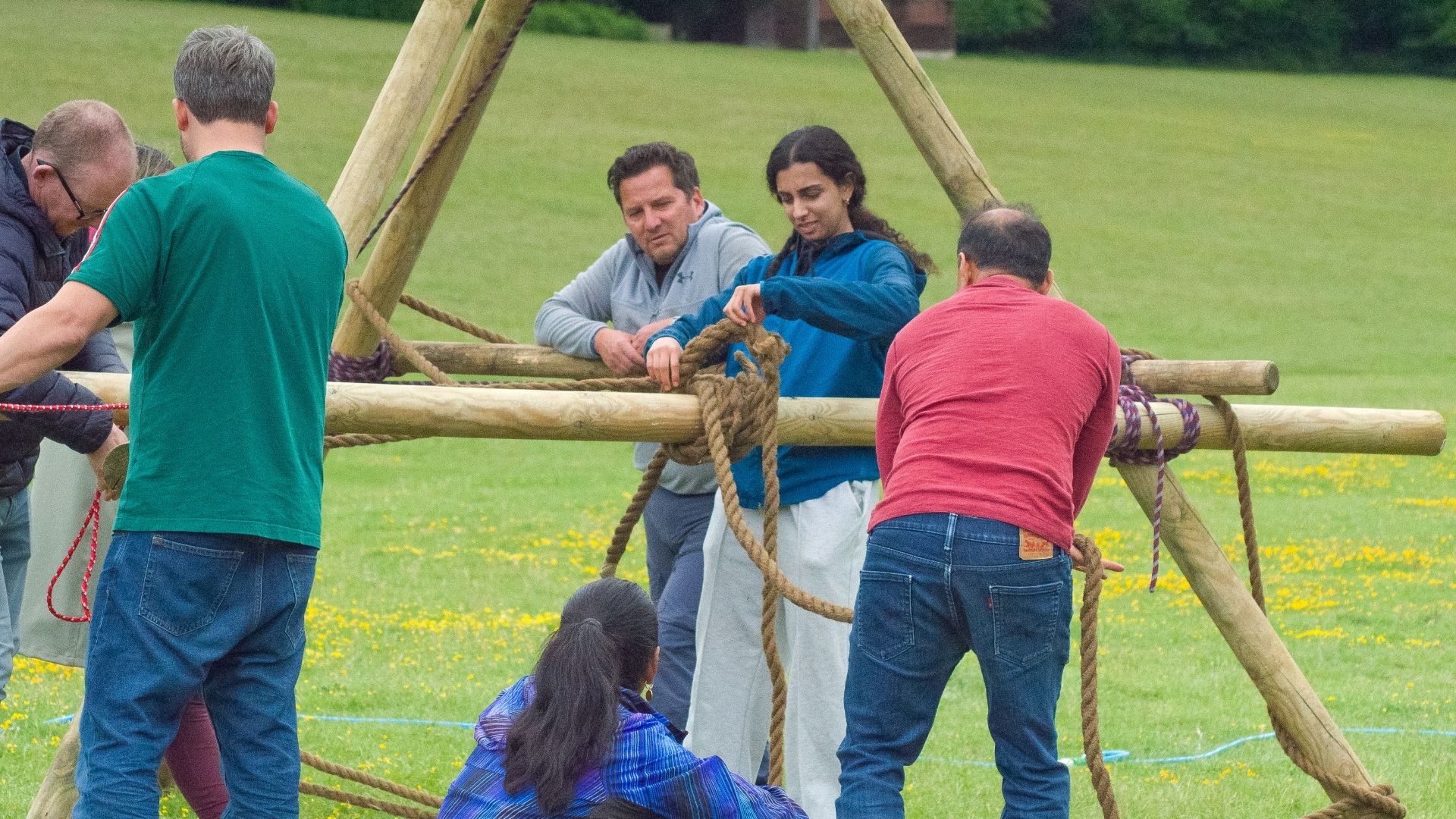
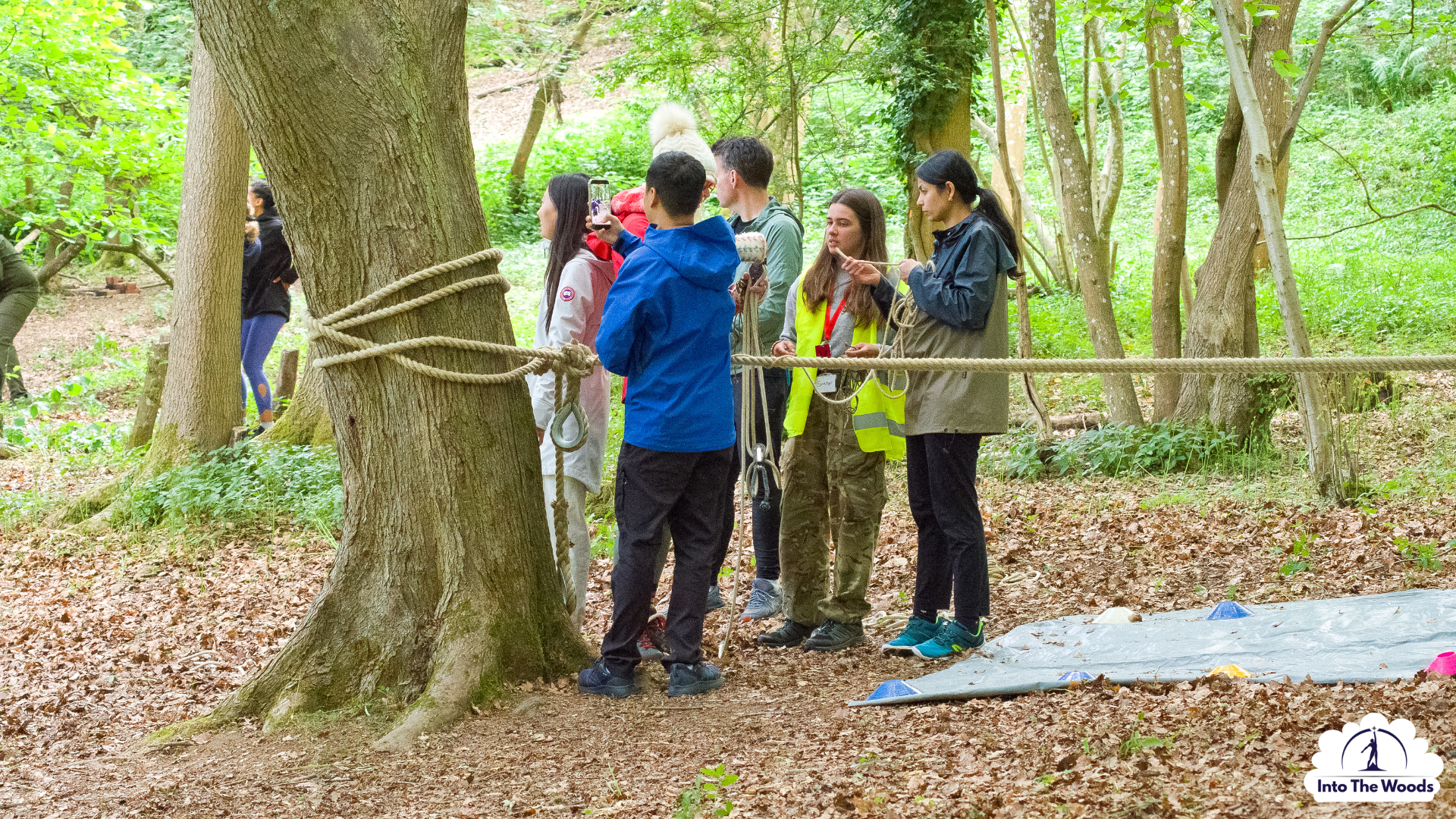
Pioneering introduces knots, lashings, and rope work to construct tripods, towers, and team structures against time constraints. Large-Scale Pioneering expands this concept into rope bridges and scaling towers built by entire groups. These epic engineering challenges require every participant's contribution.
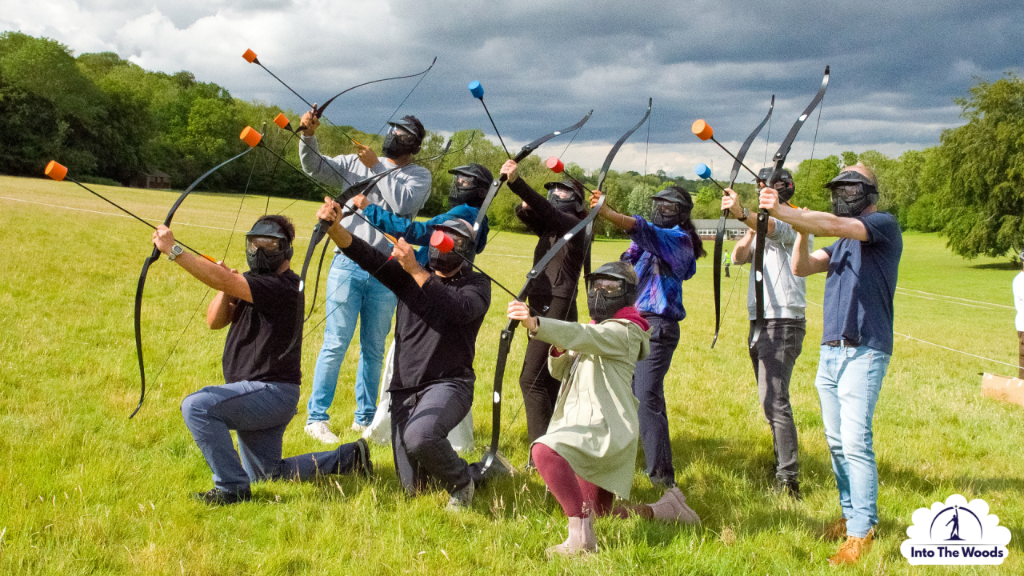
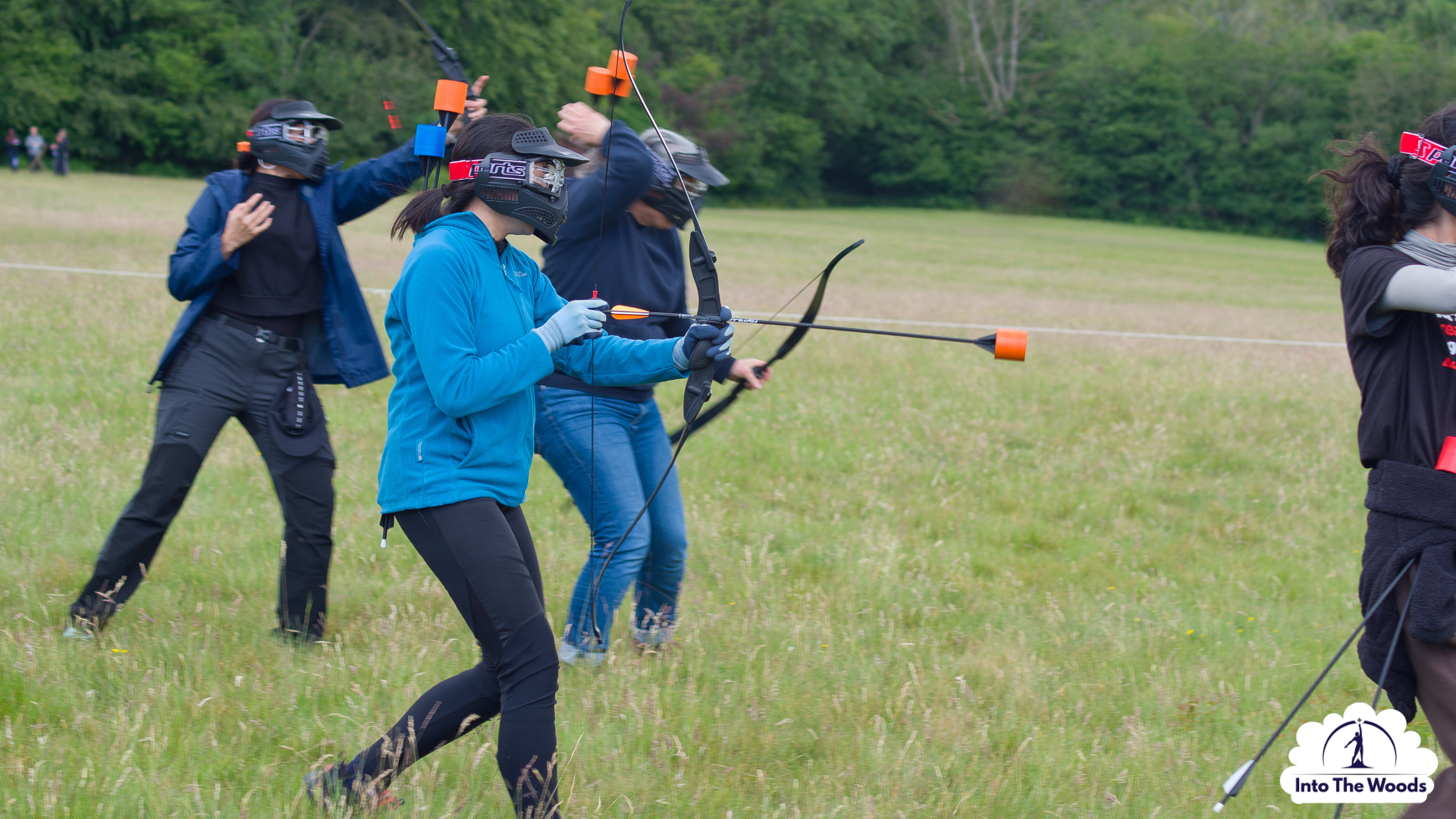
Archery Tag blends traditional archery with high-energy combat using foam-tipped arrows. It combines dodgeball dynamics with archery precision and creates scenarios where trust and communication become essential.
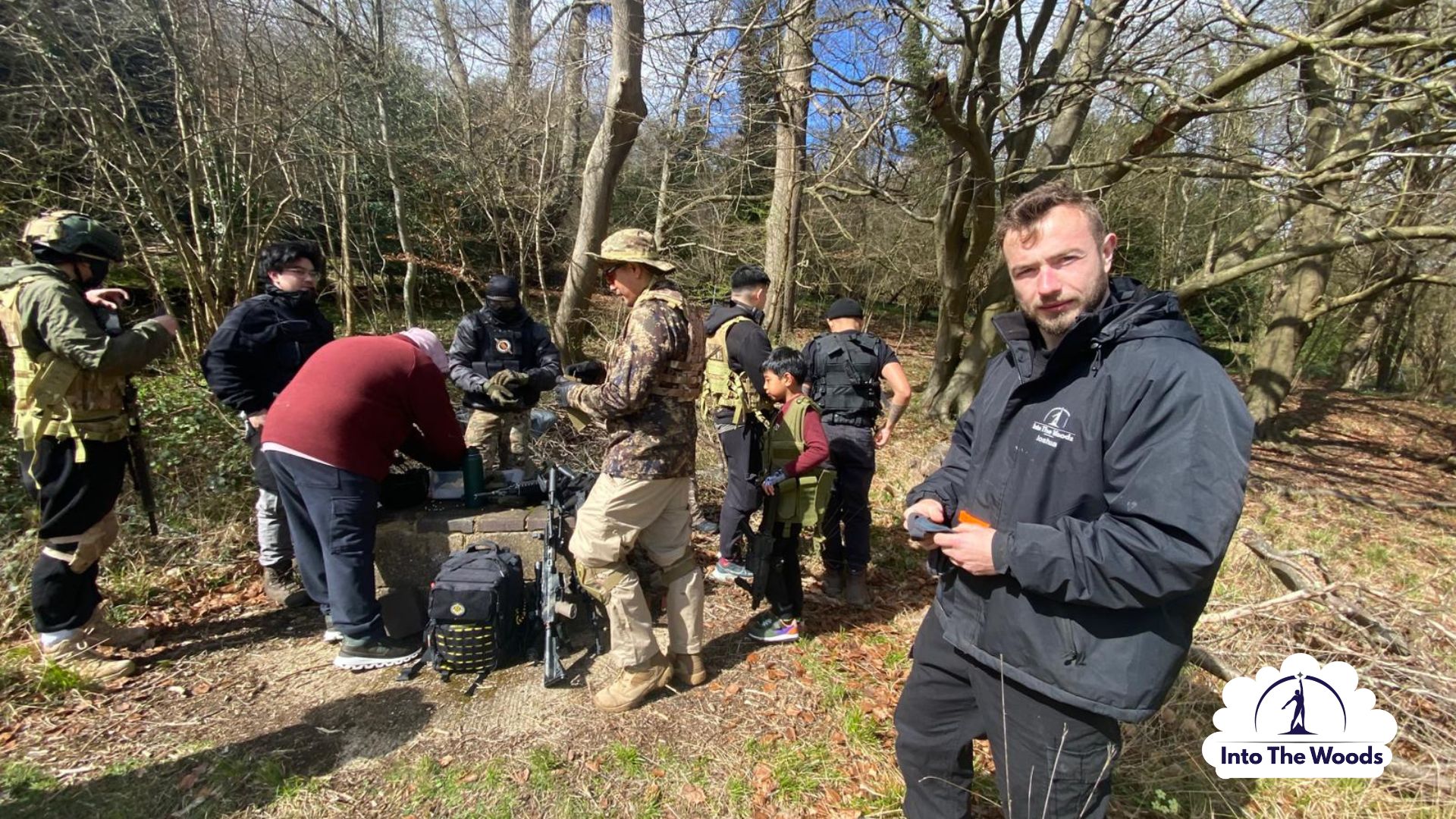
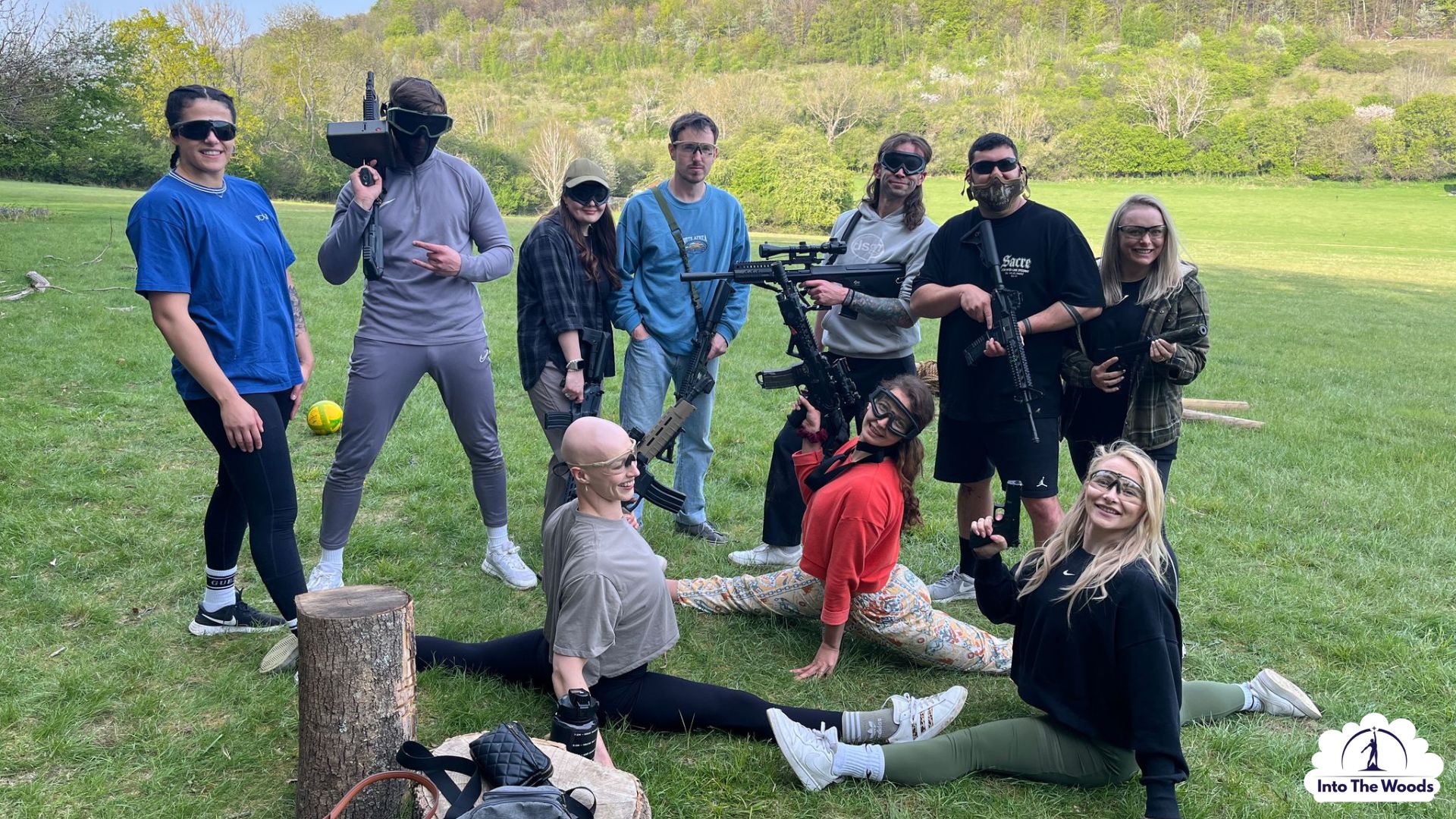
Airsoft missions place teams in tactical woodland scenarios where strategy and coordinated movement determine success.
Siege Building adds competitive engineering to the mix. Teams design, construct, and battle with catapults and siege engines under pressure. Zipline Building takes this further by having groups design, rig, and ride their own ziplines - a thrilling blend of engineering, teamwork, and adrenaline.
Command Tasks present classic leadership scenarios where groups work under time pressure with limited resources and clear objectives. These challenges reveal problem-solvers and expose communication gaps that might remain hidden in office environments.
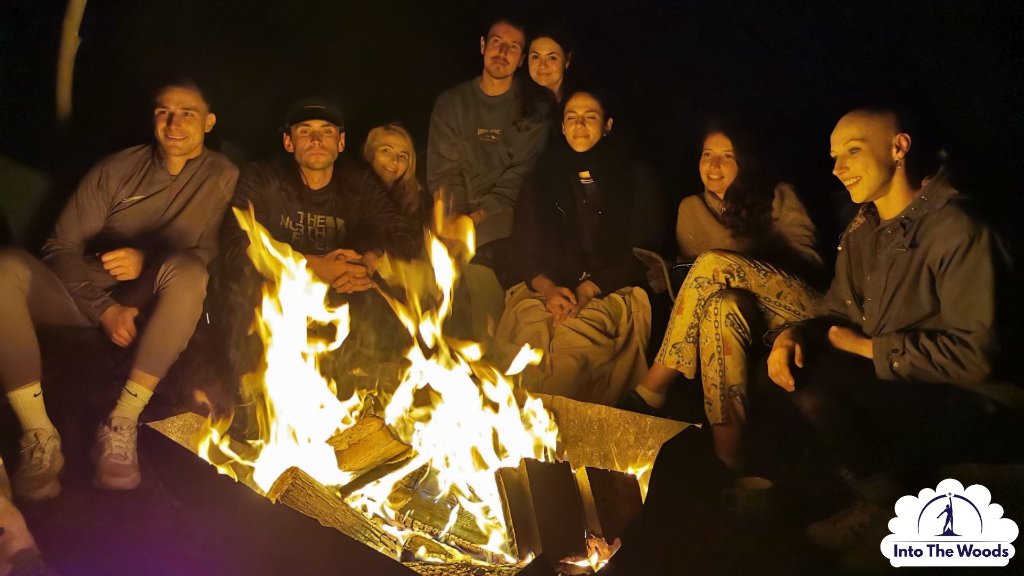
Campfire Experience creates authentic community moments. Teams cook over open fires, share stories, and experience genuine connection. This activity produces deep conversations that formal meetings never generate.
Team Sports and Physical Challenges
Company sports days promote healthy lifestyles while encouraging community within organizations. These events accommodate 25 to 200+ guests across 2 to 3.5 hours. Classic challenges include egg and spoon races, tug-of-war, welly wanging, and obstacle courses, complete with colored sports vests and novelty costumes.
The strongest sports day formats ensure inclusivity in a variety of fitness levels. Variety matters. Traditional relay races alongside less intensive games like tug-of-war ensure everyone feels included. Activities should appeal to different interests, fitness levels, and accessibility needs.
Country sports events test accuracy in rifle shooting, coordination in sheep dog handling, and precision in archery. Participants might experience falconry with birds of prey or even ferret racing. These activities suit groups seeking calmer competitive formats that still deliver sport-like engagement.
Nature-Based Problem-Solving Activities
Survival skills workshops transform bushcraft basics into problem-solving laboratories. Teams learn fire-lighting with ferro rods, construct shelters, source and filter water, and practice navigation. The sharp smell of woodsmoke centers attention on essentials while teaching prioritization, delegation, and calm execution under constraints.
Stranded survival scenarios place teams outdoors where they must prioritize actions to return to civilization. This challenge teaches potentially lifesaving bushcraft skills and lessons in leadership, delegation, multi-tasking, and communication. The Pipeline Challenge requires teams in extreme environments to plan and build water transport systems for villages in need, though communication channels remain limited.
Raft-building exercises give teams barrels, planks, poles, and ropes to design, lash, and launch rafts carrying teammates across short courses. Groups spanning 10 to 40 people divide into teams of 5 to 8 for this 120 to 180-minute activity that surfaces planning versus execution tensions. The gentle slap of water against docks heightens focus on role clarity, rapid prototyping, and iterative improvement.
Environmental conservation projects combine team building with meaningful contribution. Tree planting boosts biodiversity, habitat restoration supports local wildlife, and clean-up drives maintain natural areas. These activities create shared purpose beyond entertainment while developing collaborative skills through practical conservation work.
Corporate Event Team Building Activities for Large Groups
Scaling activities to accommodate 50, 100, or 200+ participants just needs different planning than small team exercises. Large group formats just need clear structure, visible scoring systems, and activities where everyone contributes rather than watches. Several indoor and urban formats handle substantial numbers while maintaining engagement, besides outdoor adventures with Into the Woods.
Office Olympics and Indoor Competitions
Office Olympics transforms conference spaces into competitive arenas through ever-changing challenges that need minimal equipment. The format works for groups from 25 to over 1,000 participants across 2 to 3.5 hours. Teams rotate through stations featuring air hockey, basketball, batak challenges, darts, giant buzz wire, and tabletop football.
The strongest programs balance physical games with skill-based and creative tasks. Opening flag design gives teams paper, pens, and tight time limits to create team identity before competition begins. Paper plane distance challenges reward engineering over athleticism. Desk chair slalom tests coordination and communication through guided navigation courses.
Inclusive design matters. Quieter problem-solvers and less mobile colleagues watch rather than participate when every challenge rewards speed or strength. Successful formats have memory tray challenges, team trivia sprints with rotating spokespersons, and blindfold direction exercises where verbal communication determines success. The Indoor Olympics drives energy into rooms while promoting Olympic values of tolerance, solidarity, and fair play.
Escape Room Challenges
Escape rooms naturally encourage communication, problem-solving, trust, leadership, and collaboration through immersive scenarios. Escape London hosts corporate events for up to 120 guests at the time across four London venues through coordinated multi-venue programs. The Classic 1 Hour package suits groups up to 25 people. Custom corporate events scale to 120 people across multiple venues.
Corporate bookings remain private for your group. Larger teams split into smaller units across multiple rooms and create head-to-head challenges with scores and post-game celebration time. The 3 Hour Experience has two 60-minute games plus time for food, drinks, and socializing. Prices start at £22 per person plus VAT for standard rooms.
Playing escape rooms reveals five types of participants: spotters who notice detail, tinkerers who persist through puzzles, communicators who coordinate team efforts, analytical brains who crack codes, and orchestrators who delegate tasks. The activity demonstrates that either everyone escapes or no one does. This eliminates individual success in favor of collective achievement.
Cooking Competitions and Culinary Events
School of Wok offers chef challenges, cooking for the homeless, sushi masterclasses, and beers and bao sessions designed for team-building and educational purposes. The sushi masterclass teaches teams to create various rolls while balancing color and texture, then present dishes. Cooking for the homeless combines Asian cuisine training with charity work and allows businesses to affect local communities positively.
The Cooking Academy manages end-to-end corporate cookery events across London venues that accommodate 25 to 80 guests. Prices start from £95 per head for short social experiences, £135 per head for cookery challenges with meals, and £150 for premium competitive experiences. Vaughan's Kitchen handles maximum 15 participants on-site or up to 48 for larger off-site groups, with half-day or full-day options available.
The process of preparing meals together just needs organization and team effort. Tasks exist for everyone from Gordon Ramsay wannabes to those who only know toasters and kettles. This one produces edible outcomes teams share at the end, unlike other activities.
Art Workshops and Creative Sessions
Art workshops create relaxed environments where teams express themselves through watercolor painting, photography, paper marbling, or life drawing. ACAVA's workshops in printmaking, leatherworking, and textile art work best for 10 to 15 people. Larger groups get accommodated through bespoke formats. Bookings support local arts programs that engage over 1,000 people annually across London, Essex, and Stoke-on-Trent.
Creative activities reduce stress, increase mindfulness, and improve overall wellbeing. Teams unwind and recharge through lino printing or watercolor painting, which promotes happier and more resilient groups. Art Play London offers private workshops for groups of 8 to 50 people and has Sip & Paint, pottery, candle making, and terrarium creation.
Game Show Style Competitions
Game show team building uses fun, inclusive, lightly competitive challenges to boost morale and strengthen collaboration. Formats have Jeopardy with company trivia and pop culture, Corporate Feud with survey questions, and In It to Win It featuring 60-second challenges with office supplies. Name That Tune turns meetings into music showdowns. Chopped gives teams random ingredients to create edible dishes.
Minute To Win It stands as the most popular game show format. Contestants solve challenges in just one minute. Game Show Mania combines rounds inspired by Countdown, Catchphrase, Shooting Stars, and Play Your Cards Right. Professional hosts and state-of-the-art equipment create full game show experiences with prizes and audience interaction.
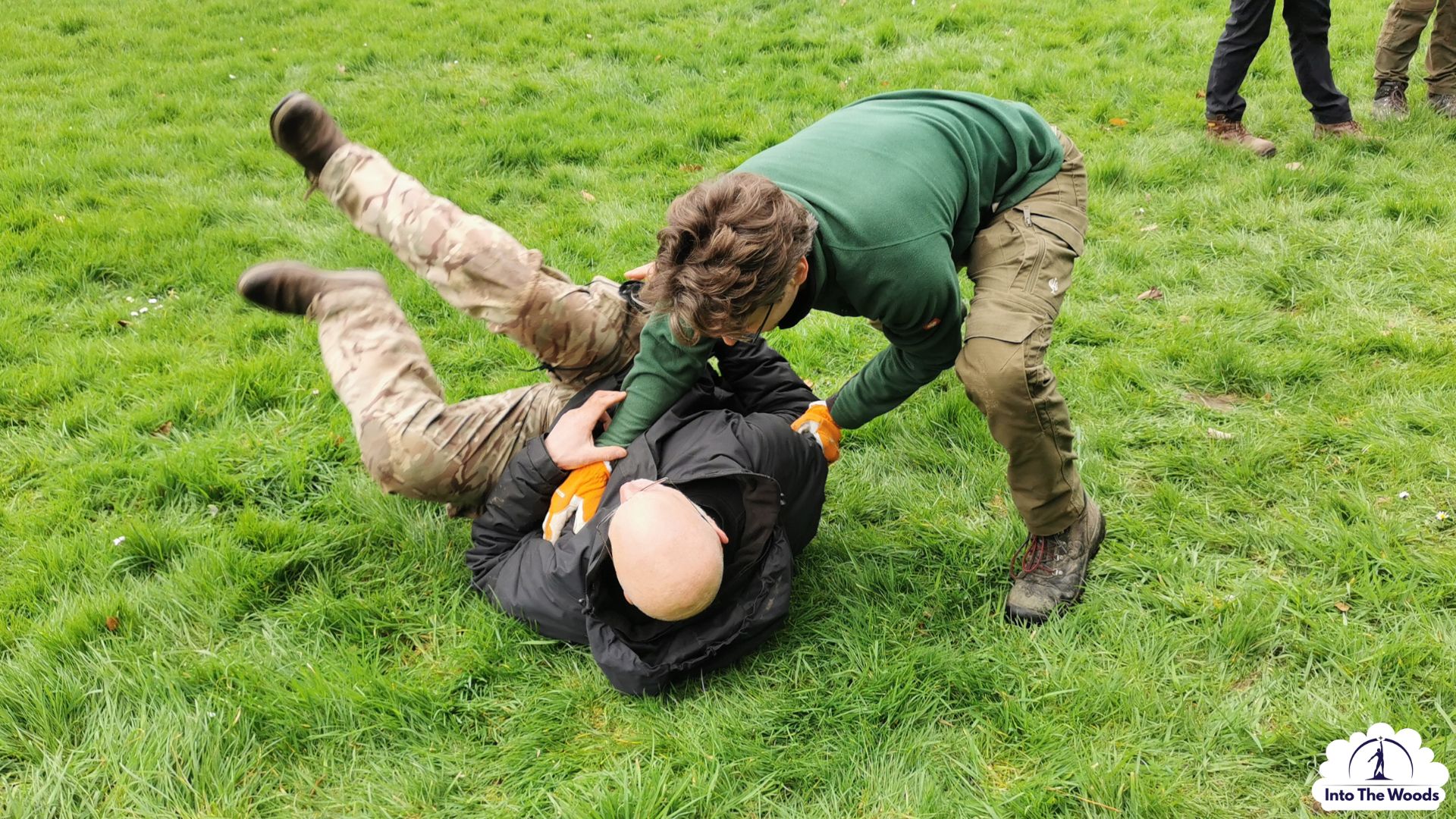
Unique Corporate Team Building Activities Ideas with Into the Woods
"We found the nature-based leadership materials offered a powerful way to re-frame how we collaborate as a team." - Danae Kyriakopoulou, Co-Head of the Bank of England's Climate Hub and Young Global Leader
Forest-Based Leadership Development Programs
Nature-based leadership development operates from different basic contours than conventional training: the environment where learning occurs shapes the quality of what emerges. Something neurologically most important happens when leaders step outside built environments and into natural ones. Forest therapy, rooted in the Japanese practice of Shinrin-yoku, invites participants to slow down, use all senses, and notice what arises without agenda. Debrief sessions that follow forest therapy walks connect the experience to specific leadership challenges.
Into the Woods delivers this through Empowerment Days and Wellness Days that combine mindfulness, breathwork, and nature connection into restorative experiences. Leadership camps in forest landscapes improve leadership qualities through forest-based challenges that bring about positive social change. Moving water produces particular effects on the human nervous system. Flowing water reduces cognitive load and induces light meditative states. Leaders working through complex decisions or interpersonal tensions produce more fluid, less defended thinking near rivers or ocean water than in indoor settings.
Walking conversations produce different results than seated ones. Physical challenge in natural settings, whether climbing or navigating unfamiliar terrain, activates body intelligence that desk-based leadership development never touches. Nature-based approaches prove especially effective for leaders highest in cognitive load: those managing complex decisions, leading through significant change, or experiencing early burnout symptoms.
Green Team Challenges in Natural Settings
Tree-planting events are one of the most influential ways to participate in sustainability efforts with teams. Group tree planting sessions give team members opportunities to contribute to environmental restoration and conservation. Teams working together to plant trees must communicate well, cooperate on tasks, and accomplish the goal of planting the most trees within set timeframes. This eco-friendly activity leaves lasting, positive imprints on the environment while improving interpersonal bonds.
Companies prioritizing green practices often reduce costs, improve brand reputation, and increase customer loyalty. Beach or park clean-ups preserve and protect nature while serving as powerful visual reminders of human activity's environmental impact. These tasks become more effective when gamified by assigning points for specific items collected or challenging teams to create upcycled art from collected trash, which drives home the importance of conservation.
Wildlife sanctuary or nature park outings encourage staff members to connect with Earth's flora and fauna. Guided excursions, nature hikes, or wildlife-spotting activities encourage teamwork and curiosity, promote stress relief, and help team members problem-solve together in unfamiliar environments. These wildlife encounters offer opportunities to learn about conservation efforts for endangered species and ecosystems.
Bushcraft and Outdoor Skills Workshops
Into the Woods specializes in bushcraft courses that transform wilderness skills into profound team development experiences. The 6.5-hour Bushcraft Course has orienteering to survival areas, fire lighting demonstrations with different methods, fashioning materials for cooking, food preparation over open fires, and woodland shelter demonstrations using natural materials. These courses accommodate up to 20 participants at a time in secluded woodland close to reservoirs.
Tailored experiences incorporate professional skills building or simply getting out of the office to unwind. Previous corporate events have featured 24-hour overnight experiences with spit roasts, bushcraft activities, and leadership reflection activities based on survival scenarios. Scenario-based courses require teamwork and creative thinking. They encourage participants to think outside the box when dealing with problems.
Into the Woods offers Tool Skills & Safety sessions that teach safe use of axes, saws, knives, and woodland tools. First Aid training provides practical outdoor first aid in remote environment contexts. Prepping covers practical preparedness skills that include food storage, water sourcing, emergency planning, and self-sufficiency in the wild. These workshops are not theoretical. Participants build real fires, construct actual shelters, and develop genuine competence.
Environmental Conservation Projects
Environmental conservation projects combine meaningful contribution with skill development. Beach clean-up activities allow teams to work together cleaning beaches while learning about marine pollution and its environmental impact. Each participant monitors collected waste and contributes to citizen science and data collection for research purposes. This activity promotes social responsibility and teamwork while benefiting marine ecosystems.
Navigation and sustainability experiences offer unique combinations of sailing, environmental monitoring, and scientific education. Teams board sailboats to explore seas and collect data on biodiversity, water quality, and other environmental parameters. Marine biologists accompany teams and teach them how to monitor marine ecosystems and understand the importance of scientific research for ocean protection.
Upcycling challenges task teams with creating beautiful, useful, or unique items from discarded materials like plastic bottles, scrap paper, or broken furniture. Teams split into smaller groups and design functional office equipment or attractive decorations. Team members cooperate, communicate, and create throughout these challenges.
Adventure-Based Learning Experiences
Adventure-based learning provides physical and intellectual problems for groups to solve. Group challenges help people explore issues of leadership, cooperation, and conflict. Hands-on activities provide laboratories for people to experiment with different ways to lead or support teams. Groups make decisions in the moment, so adventure-based learning helps groups see their own dynamics more clearly.
Outdoor adventure learning involves climbing, mountaineering, survival courses, ropes courses, or outdoor sports like orienteering and canoeing. These experiences include shared learning with high levels of physical and often emotional challenge. Practical problem-solving, explicit reflection, and discussion of thinking and emotion are essential. Studies report wider benefits in terms of self-confidence and self-efficacy.
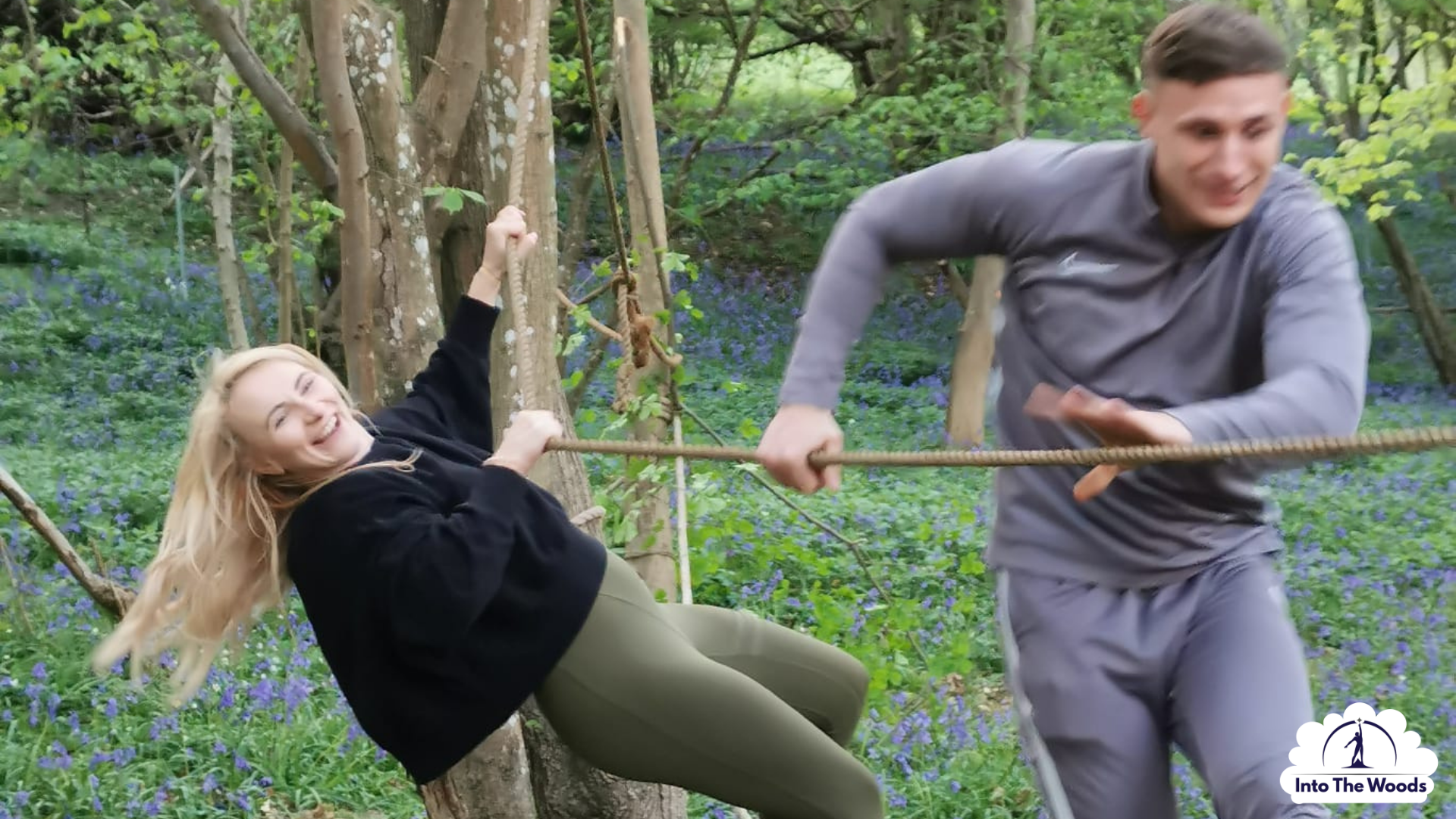
Into the Woods structures adventure-based learning through activities like Zipline Building, where teams design, rig, and ride their own ziplines. Large-Scale Pioneering creates rope bridges and scaling towers built by entire groups. Poetry & Creative Writing sessions find voice in the woods through guided creative writing inspired by natural environments.
Get a quote for team building with Into The Woods to explore how forest-based programs can develop your leadership team while creating genuine environmental impact.
Planning and Implementing Successful Team Building Activities for Corporate Companies
Assessing Team Needs and Goals
You need to assess where your team stands before selecting corporate team building activities. High-performance teams require design, not guesswork. Start by identifying specific objectives: whether improving communication, building trust, or enhancing problem-solving skills. Team assessments measure 31 dimensions of leadership effectiveness and reveal gaps between current and desired performance. Dysfunction shows as missed deadlines, communication breakdowns, or unresolved conflicts. You can intervene proactively when you identify these patterns early. Team surveys completed anonymously, one-on-one discussions, and experiential exercises provide baseline data. Your team's unique needs determine whether wilderness survival with Into the Woods or indoor workshops serve you better.
Budget Considerations and ROI
Corporate team building activities typically cost between £50 to £150 per person for half-day experiences. Venue costs represent 25-40% of total budgets. Facilitator fees, catering, and logistics comprise the remainder. Small companies often invest £79 to £127 per person, while large organizations achieve economies at £40 to £71 per head. Employee retention provides the clearest ROI measurement. Replacing one employee costs £30,614 when you factor in 28 weeks to full productivity. Teams with strong cohesion reduce turnover by 87%. Calculate ROI by comparing measurable financial gains against total event spend.
Choosing the Right Activities for Your Team
Match activities to specific team dynamics and desired outcomes. Teams struggling with communication benefit from collaborative problem-solving challenges. Groups lacking energy thrive with active formats. Group size influences selection by a lot. Most corporate team building outdoor activities accommodate 8-20 participants optimally. Think about physical capabilities honestly. Survey team members about limitations, interests, and concerns. Into the Woods offers unique alternatives to standard activities: Shelter Building reveals natural leaders, Pioneering teaches delegation under pressure, and Campfire Experience creates authentic connection impossible in conference rooms. Get a quote for team building with Into The Woods to explore wilderness-based options beyond typical corporate events.
Logistics and Safety Planning
Safety requires you to identify all potential risks beforehand. Conduct precise evaluations of dangers and implement appropriate measures. Precautions you need include appropriate liability insurance coverage, available first aid kits, qualified professional supervision for each activity, and weather contingency plans. Clear briefings before programs prevent incidents and reassure participants. Monitor forecasts closely for outdoor corporate team building activities and communicate backup plans well in advance. Choose venues that balance accessibility, amenities, and activity requirements. Proximity affects transportation logistics and participation rates. Whether you organize Fire Lighting sessions or Large-Scale Pioneering, ensure certified guides manage technical aspects while you focus on team dynamics.
Measuring Success and Follow-Up
Team building that works represents ongoing effort, not one-time events. Only 43% of workforce members express positive team climate currently. Measurement proves your investment delivered tangible business value. Establish baseline metrics before events: employee engagement scores, team cohesion ratings, voluntary turnover, and project completion times. Post-event surveys within two weeks capture perception changes around communication, trust, and morale. Follow-up assessments at three and six months reveal whether behavioral changes persist. Track key performance indicators that reflect behavior and output rather than short-term enthusiasm. Productivity indicators include smoother workflows, fewer errors, and reduced turnaround times. Absenteeism and retention trends signal whether the team environment became more supportive. Compare pre and post-event data to calculate the effect. Immediate energy after events is common but does not reflect lasting effect. Short-term feedback alone misleads without follow-up measurement. Sustained improvements in collaboration, communication, and output suggest experiences translated into everyday work.
Comparison: Corporate Team Building Activities Guide
| Section | Main Goal | Key Benefits | Activities Featured | Group Size | Measurable Outcomes | Into the Woods Integration |
|---|---|---|---|---|---|---|
| The Strategic Benefits of Corporate Team Building | Establishing the business case for team building. | Improved productivity, retention, trust, and innovation. | Research-backed approaches and psychological safety creation. | All team sizes. | 35% higher productivity; 23% greater profitability; 87% less likely to leave; £30,614 replacement cost. | Wilderness survival, bushcraft, siege building, zipline, campfire, and command tasks. |
| Corporate Team Building Outdoor Activities | Moving beyond standard indoor activities to authentic outdoor challenges. | Natural collaboration and physical engagement. | GPS treasure hunts, F1 Method, dragon boat racing, wilderness survival, fire lighting, shelter building, pioneering, archery tag, airsoft, siege building, zipline, command tasks, campfire, sports days, survival workshops, raft-building, and conservation. | 6-200+ participants depending on activity. | Activities lasting 1-3.5 hours; raft-building for 10-40 people in teams of 5-8 over 120-180 minutes. | Fire Lighting, Shelter Building, Pioneering, Large-Scale Pioneering, Archery Tag, Airsoft, Siege Building, Zipline Building, Command Tasks, and Campfire Experience. |
| Corporate Event Team Building for Large Groups | Scaling activities for substantial participant numbers while maintaining engagement. | Inclusive design, visible scoring, and active participation for all. | Office Olympics, escape rooms, cooking competitions, art workshops, and game show competitions. | 25-1,000+ participants. | Office Olympics over 2-3.5 hours; escape rooms from £22pp; cooking £95-£150 per head. | Outdoor alternative to indoor and urban formats for large groups. |
| Unique Corporate Team Building Ideas with Into the Woods | Differentiating through nature-based, wilderness-focused experiences. | Leadership development, environmental impact, and bushcraft competence. | Forest-based leadership, Empowerment Days, Wellness Days, tree-planting, wildlife outings, bushcraft courses, tool skills, first aid, prepping, zipline, poetry, and conservation. | Up to 20 for bushcraft courses; adaptable for various group sizes. | 24-hour overnight experiences available; 6.5-hour standard bushcraft course. | Full program showcase - Fire Lighting, Shelter Building, Pioneering, Tool Skills, First Aid, Prepping, Empowerment Days, Wellness Days, Poetry, Zipline, and Large-Scale Pioneering. |
| Planning and Implementing Successful Team Building | Planned approach, execution, and measurement of team building initiatives. | ROI measurement, safety planning, needs assessment, and sustained behavioral change. | Team assessments, budget planning, activity matching, logistics, success metrics, and follow-up measurement. | All team sizes; optimal 8-20 for most outdoor activities. | £50-£150 per person for half-day; £79-£127 for small companies; £40-£71 for large organizations; 87% turnover reduction; 43% positive team climate currently. | Shelter Building, Pioneering, Fire Lighting, Large-Scale Pioneering, and Campfire Experience as examples for matching activities to team dynamics. |
Conclusion
Standard team building activities cycle through the same predictable formats year after year. Conference room workshops and trust falls will not deliver the measurable results your business needs. Wilderness-based experiences like Fire Lighting, Shelter Building, and Siege Building create authentic challenges that standard approaches cannot replicate. These activities reveal natural leaders and build trust. They develop skills that transfer to workplace performance. Get a quote for team building with Into The Woods to explore how forest-based programs move beyond typical corporate events. Your team deserves experiences that create lasting effects, not just temporary enthusiasm.
FAQs
Q1. What types of corporate team building activities deliver the best results?
The most effective activities combine physical challenges with problem-solving elements in unfamiliar environments. Wilderness-based experiences like shelter building, fire lighting, and pioneering projects create authentic collaboration scenarios where teams must communicate clearly and leverage each member's strengths. Activities that push groups outside their comfort zones while maintaining psychological safety tend to produce the strongest outcomes, as they reveal natural leadership qualities and build genuine trust that transfers back to the workplace.
Q2. How do outdoor team building activities differ from traditional indoor approaches?
Outdoor activities place teams in natural environments where collaboration must occur organically rather than through structured exercises. Unlike predictable conference room workshops, wilderness challenges like navigation tasks, survival skills training, and adventure-based learning create real consequences for decisions and require immediate teamwork. The unfamiliar outdoor setting breaks down hierarchical barriers and encourages participants to engage authentically, often revealing hidden strengths and communication patterns that remain invisible in office environments.
Q3. What should business leaders consider when planning team building events?
Start by assessing your team's specific needs - whether improving communication, building trust, or enhancing problem-solving capabilities. Budget typically ranges from £50-£150 per person for half-day experiences, with venue costs representing 25-40% of total spend. Match activities to your team's physical capabilities and group size, as most outdoor activities work best with 8-20 participants. Establish baseline metrics before the event and plan follow-up assessments at three and six months to measure sustained behavioral changes rather than just immediate enthusiasm.
Q4. How can companies measure the return on investment for team building activities?
Track concrete metrics like employee retention rates, productivity indicators, and absenteeism trends before and after events. Teams with strong cohesion reduce turnover by 87%, which matters significantly since replacing one employee costs approximately £30,614 when factoring in the 28 weeks required to reach full productivity. Compare pre-event and post-event data on communication effectiveness, project completion times, and team cohesion ratings. Sustained improvements in collaboration and output over several months indicate that experiences translated into lasting workplace benefits.
Q5. What makes wilderness-based team building activities particularly effective for leadership development?
Nature-based environments create neurologically significant shifts that conventional training cannot replicate. Forest settings reduce cognitive load and induce reflective states that help leaders work through complex decisions with less defensive thinking. Physical challenges in natural terrain activate body intelligence and reveal leadership qualities under pressure. Activities like building shelters, mastering fire-lighting techniques, or constructing rope bridges require immediate delegation, strategic planning, and trust-building in ways that desk-based leadership development never touches, making the lessons more memorable and applicable.
Ready to experience the woods for yourself?
See Upcoming Events